We assumed.
We assumed and we started to plan, as though all that was left was tying up some gift ribbons and signing the greeting card.
We forgot, in the process, that the Yankees still had to win the game.
They had to win the game, in Anaheim, against the best Angels pitcher. Even on paper it was no easy thing.
We assumed, and we were wrong.
You can attach blame wherever you'd like, though only assigning blame does not do much. As my father has told me, some are in love with assigning blame and others prefer to fix problems.
So, here we go:
Some will blame AJ Burnett, some Joe Girardi, and some Phil Hughes.
I am no baseball manager and I've never played in an organized baseball game, but this is what I would have done:
In the seventh inning, I let Burnett come out to start the inning. He's at 80 pitches and has more or less been doing all right since that let's-not-talk-about-it first inning.
Once Mathis reaches, that's when I replace Burnett, instead of giving him the chance to put the tying run on base.
The reliever I bring in is not Phil Hughes or Joba Chamberlain, but David Robertson. I know, it doesn't make a lot of sense, but both Hughes and Chamberlain have been hit this postseason and Robertson has more or less worked some miracles.
At this rate, Robertson right now is the most valuable reliever not named Mariano Rivera.
This isn't to detract from what Hughes or Chamberlain have done this season--and without Hughes, especially, the Yankees aren't even playing tonight--but both have had issues this postseason.
If I leave AJ in to face the first two batters and they both reach, I consider bringing in Mariano Rivera. It's undoubtedly the highest leverage situation at that point, but my issue arises if the Yankees don't add any more insurance runs and the game goes to the ninth still a two run game and your team on the road.
***
Unlike most of you, I suspect, I'm not all that bothered by Girardi's decision to pinch run for Alex Rodriguez in the ninth.
With two outs, and down by one, you do anything you can to tie the score, and while Rodriguez isn't a Molina, Guzman is much more likely to score from first. Again, your team is down two outs, so you don't have any more outs with which to work.
Nick Swisher, of course, killed us all with the 3-2 pop up. I don't know if he was swinging at ball four or not, but the Yankees lost the game in the seventh, after coming so close to winning.
***
So we go back to New York.
The forecast on Saturday calls for rain and thunder.
After everything that's happened this season, the possibility of being able to clinch at home, in the rain--possibly even, well, you know how--has a certain romanticism to it.
October baseball lives on.
Thursday, October 22, 2009
When you assume...


Monday, October 12, 2009
Constructing the ALCS Roster
The cool thing about the postseason is that teams that advance to the next round can adjust their roster, for whatever reason--maybe someone gets hurt, maybe someone is better against one team than another.
With the ALDS over, the Yankees can now construct their ALCS roster.
This roster will largely remain the same--the differences come down to basically whether or not, against the Angels, you want an extra pinch runner or an extra arm out of the bullpen.
For the ALDS, the Yankees went for the extra bullpen arm and stuck with just Brett Gardner and Jerry Hairston as pinch runners.
Here is the way I'd construct the roster for the ALCS, bold selections are explained below:
1) Derek Jeter
2) Johnny Damon
3) Mark Teixeira
4) Alex Rodriguez
5) Hideki Matsui
6) Jorge Posada
7) Robinson Canó
8) Nick Swisher
9) Melky Cabrera
10) CC Sabathia
11) AJ Burnett
12) Andy Pettitte
13) Chad Gaudin
14) Brett Gardner
15) Jerry Hairston, Jr.
16) Freddy Guzman
17) Jose Molina
18) Francisco Cervelli
19) Eric Hinske
20) Joba Chamberlain
21) Phil Hughes
22) Mariano Rivera
23) David Robertson
24) Alfredo Aceves
25) Phil Coke
Chad Gaudin/Joba Chamberlain: I put Gaudin in fourth starter's spot because, at the moment, I have more confidence in his ability than I do in Joba's. There are a couple of points here: Joba has not started since his final start of the season, which I was, uh, fortunate enough to attend in person. He was, more or less, awful.
While Gaudin, through the course of the season, was a roll of a dice once one hit the sixth inning, the five innings he did get through were much cleaner than those Joba pitched.
It's entirely possible, come Game 4, depending on what the scenario is, that Joe Girardi asks CC Sabathia to go on three days' rest and thus the Gaudin/Joba debate becomes moot. Still, Girardi has shown a tendency to play-by-the-book and it's hard for me to imagine him, in the ALCS, asking Sabathia to go on such short rest unless the Yankees were down 3-0 in the series.
There's no question about keeping Joba on the roster, merely a question of where he would best be used. If you think Joba, and not Gaudin, should be the game four starter, please feel free to say so in the comments.
Freddy Guzman: My major move here is that I take Damaso Marte off the roster and put Freddy Guzman on it. It's not just that Marte was completley ineffective in his one appearance, but that if Johnny Damon continues to struggle as he is, Girardi might give a thought to starting Gardner--the considerable loss of potential power may, in fact, be negated by the improvement in outfield defense--and having Guzman on the bench means that doing so would not leave Girardi without a pinch runner for Posada or Matsui.
I still remain of the opinion that if you're going to have someone not named Jorge Posada catch--which I don't agree with, but can live with--that your better option is Cervelli, who is a more than adequate defender and not an automatic out in the line up.
Since there's utterly no chance of Girardi removing Molina for Cervelli, however, I will have to let the three catchers stand as is. If the Yankees are going to start Molina, they almost have to carry Cervelli--as, in game 2, if Posada pinch-hits for Molina and then someone pinch runs, you still need another catcher.
It's extraordinarily tempting to want to add another pitcher. Six doesn't seem like enough, and while I still stay far, far away from Brian Bruney, there's a part of me that doesn't have any issues with putting Mark Melancon on said roster, even if he's just along for the ride in the sense that Jeter and Rivera were in 1995.
If you keep Guzman on the roster, and you don't remove either Molina or Cervelli, the tempting thing to do would be to remove Eric Hinske--Hairston is probably better defensively in the outfield, and certainly the faster runner--but the extremely superstitious person in me balks. Hinske's got some seriously good World Series luck that you don't want to touch.
It's pretty amazing how intricate the arguments can be when choosing between just one or two players that, all told, are not expected to have an impact on the series the way that Derek Jeter or Alex Rodriguez might, but then, it's not too hard to remember how Luis Sojo and Jose Vizcaino basically won the 2000 World Series for us, and then we know the importance of every spot on the roster.
Wednesday, October 7, 2009
Ghosts? What ghosts?
The common refrain going around the Yankee fan base right now is that while nothing is guaranteed, and that the Yankees are not guaranteed to win their series against the Twins, there is a different feel around this year's squad than there has been in many years. This team is likable, fun to root for and really, really damned good.
So nevermind CC Sabathia's less than stellar postseason ERA or Alex Rodriguez's absence of a decent postseason since the ALCS of 2004.
This is a team where expectations are not just high for the free agents signees who make more in a year than some entire countries, but for those who have played only for the Yankees and those who came to the Yankees in unheralded trades. The team won 103 games in the regular season, and one or two players can't win 103 games all on their own. Though, God knows Albert Pujols tried.
As with any beginning, there are opening ceremonies of a sort. With the ALDS it's nothing too spectacular--full line ups and guys in uniform, but it's somewhat muted. It's good to be here, but there's still a while to go before the grand prize.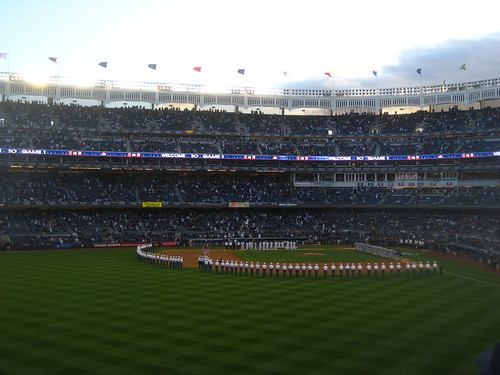
When the players are introduced, some receive particularly loud accolades--like Mariano Rivera and Derek Jeter--while others receive, well, lots of non-accolades. Like Carl Pavano.
Because of the odd start time, the Stadium was still fairly empty as the lineups were being announced.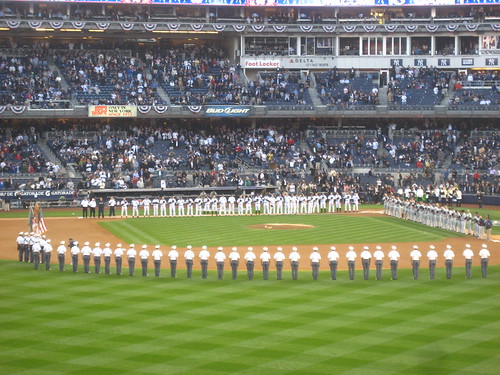
By the time the first pitch was thrown, however, almost every seat was filled.
The National Anthem always seems to add a sense of "this is it, this is what we live for."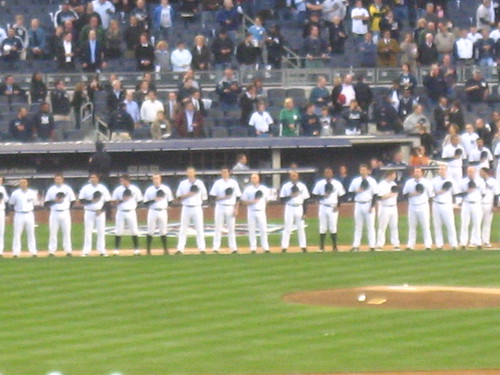
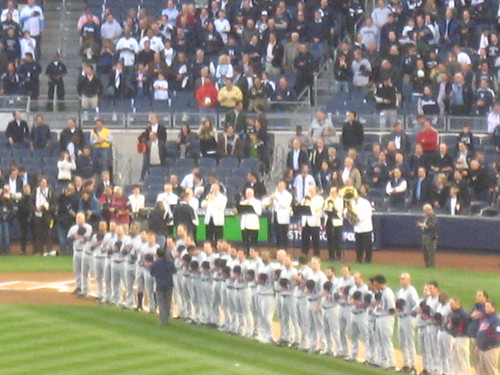
As the Yankees take the field, there is a rush of excitement. As stated earlier, if you're a fan at that Stadium at that time, you're either way amped up, or you're dead.
With no other game going on at the present moment, the scoreboard instead displays the line up of both teams, highlighting the next batter to come to bat.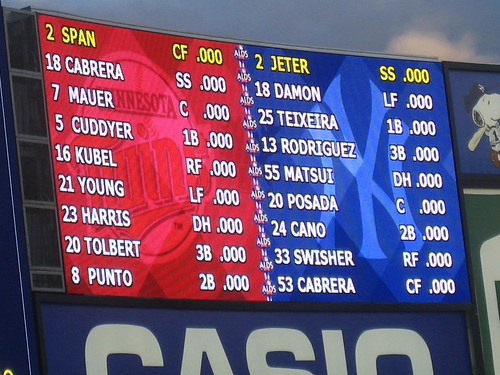
The blazing lights against the sunset make for an auspicious early game atmosphere.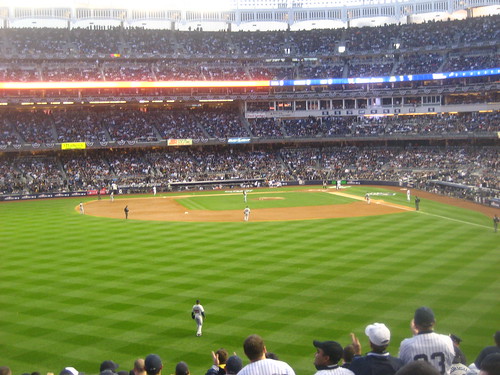
The Twins took an early 2-0 lead that could have never have been: had a close pitch been called a strike three, CC Sabathia would have gotten out of the inning. Instead, a couple hits and a passed ball, and the Twins had a 2-0 lead.
That lead was, however, short lived.
Reason A: Derek Jeter
Jeter has done a lot of great things in his career and is something of an immortal among Yankee fans. Hitting a left field home run to tie a game? Awesome. And in the postseason? Well, there's only one Derek Jeter.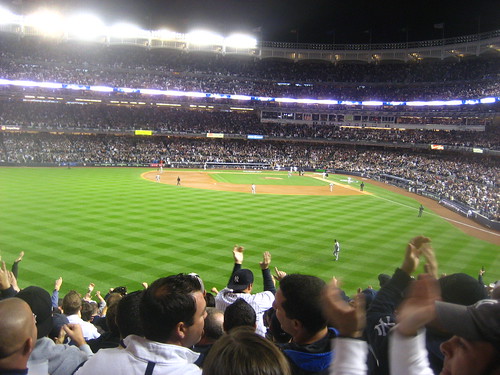
Hit a home run like that, then hear the entire Stadium erupt in chants of M-V-P! M-V-P! (Yes, we know it's going to Mauer. No, we don't care.)
Meanwhile, Sabathia must have been somewhat mindful of his rapidly escalating pitch count: he settled down and started to deal.
Despite having over 70 pitches after the fourth inning, Sabathia pitched into the seventh inning and did not walk a single batter.
The Twins were the first to go to their bullpen--by this time the Yankees had already taken the lead.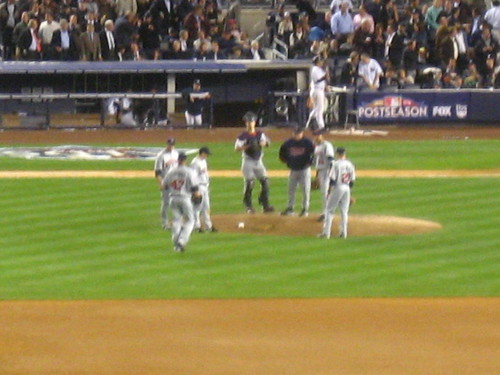
Who did the Twins call upon?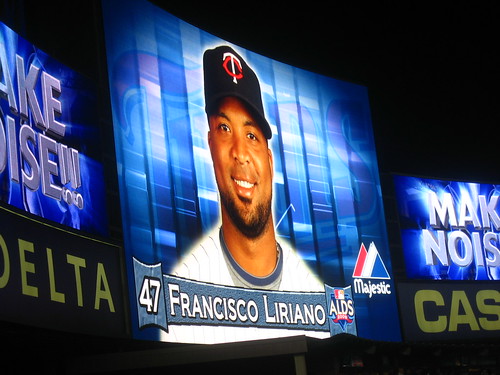
I swear I'm not making this up.
Not too long afterwards, Hideki Matsui hit a home run--the type that screams HEY YAY INSURANCE RUNS! My friend Brent summed up our reactions pretty well.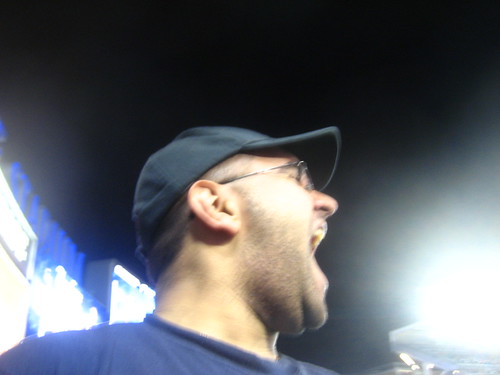
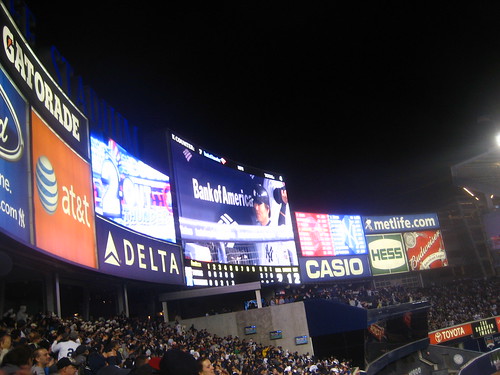
With two outs in the seventh inning and the Yankees with a four run lead, Joe Girardi did the prudent thing and went to the bullpen before Sabathia's pitch count approached abusive levels. He left to a raucous ovation.
In came Young Master Hughes.
There was a massive Orlando Cabrera at bat just to end the seventh inning, but Hughes got the job done, and instead of having to face Joe Mauer with the bases loaded, Joe Mauer came up in the 8th with no one on.
This is the only game I've ever been to where I've actually heard people sing "God Bless America".
It was a stirring rendition courtesy of the NY Pops
This is just a really awesome late-game shot: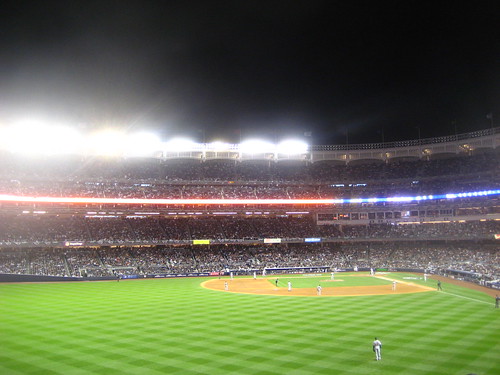
Out went Phil Hughes, and in came Joba Chamberlain. Phil Coke also made an appearance and had the best possible appearance for a reliever: one pitch, one out. It was nearly a double play, but Mauer was just a shade too nimble for Teixeira.
With a five run lead--and here it should be noted that two of these runs, yes two are the direct responsibility of Alex Rodriguez, something you haven't seen in an October write up for a while--it perhaps seems strange that the Yankees bring in their closer, but this is October. You don't take chances.
Enter Sandman. Exit Twins.
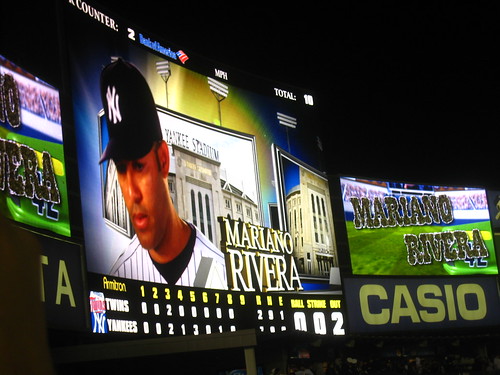
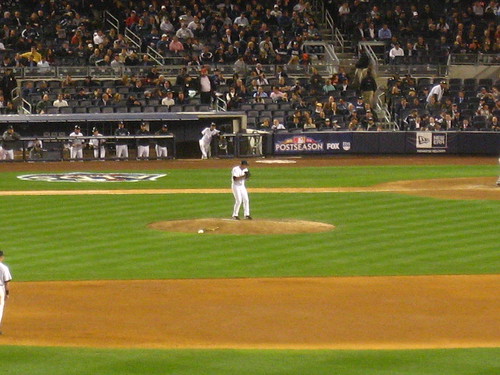
Magic number, that real magic number that all Yankee fans really care about, is now down to ten.
And we'll see you Friday night!
Friday, September 25, 2009
Joba pitches well, Melky takes out Lester, Yanks win (postgame notes 25 September 2009)
As per my post on TYU:
While beating the Red Sox always makes for interesting storylines of its own, tonight's game produced two occurrences of note:
1) Joba Chamberlain pitched well. If anything, Chamberlain may have been hampered by the long innings the Yankees had at the plate, but he pitched six innings completely and used only 86 pitches to get there.
2) Melky Cabrera took Jon Lester out with a liner off of the plant leg. Officially, it's a contusion on the quadriceps, but every fan of the Red Sox has got to be concerned--Lester appeared to be in serious pain, and he is easily one of the two best Red Sox pitchers (though he didn't pitch like it tonight.)
The Yankee offense has Alex Rodriguez to thank tonight--his four RBI ended up as the difference in the final 9-5 score.
It should also be mentioned that the Yankees ran roughshod over Boston's defense, stealing bases at will and not even coming close to getting caught.
***
Much of the broadcast tonight was taken up by Michael Kay and Al Leiter arguing that the current postseason format does not penalize the Wild Card slot enough.
While I don't agree with everything the two brought up, there are two points with which I do agree:
1) a five game series is too short of a series. It benefits the team with a better 1-2 starting rotation; not a better team.
2) Give the top two teams in the league a first round bye. Then, the Wild Card team or teams will have to exert more energy and more strategy in that first round. Think of an NFL-like scenario, though ostensibly without six teams.
Monday, September 21, 2009
Joba this, Joba that
Joba Chamberlain is "only" the Yankees fourth starter come playoff time.
He won't start until the ALCS, and the Yankees have to make it there first, before they can worry about winning it.
The problem is, what happens when Game four ends up being a pivotal game? Game four, after all, is much more likely to be a pivotal game where one team has a chance to take a 3-1 series lead than it is a chance for the Yankees to sweep their opponent.
The problem with Chamberlain is that the issue doesn't end with him not pitching well--yesterday's performance in Seattle was especially ugly--but that Chamberlain doesn't even admit he's not pitching well.
Check out the audio from LoHud.
At this point in time, Chamberlain is the Yankees' fourth starter only because no other option has presented itself. Sergio Mitre has been so bad he's been banished the the bullpen, and Chad Gaudin falls apart like clockwork after the fifth inning.
River Ave Blues makes an interesting point that the Yankees have brought up Ian Kennedy, but after barely pitching all year due to his injury, he can't seriously be expected to pitch in the playoffs...right?
Right now, the Yankees just need to win one more game--or have Texas lose one more game--to make the playoffs. The division will be a bit harder to come by and the Yanks are doing a good job of making it interesting, but the Yankees should still get that, too.
Thus, the issues of discussion tend to revolve around what will be done in the playoffs. It's clear at this point that the biggest issue the Yankees have going into the playoffs is their starting pitching, and perhaps nothing looms larger than Chamberlain.
We tend to forget Chamberlain's still a young pitcher in his first full year in the rotation, who was hurt last year and is invariably going to struggle. Because he was so good so fast in 2007, we don't allow ourselves the possibility of him struggling. This is perhaps our fault; however, the refusal to admit he's pitching poorly is no one's fault but his own.
Saturday, September 5, 2009
Joba's Troubles Concerning
The Yankees, as of September 5th 2009, do not have a lot of concerns.
They have the best record in baseball by a decent margin and have had quite a few win streaks of seven games or more. Losses are rare; the team has lost only two series entirely since the All Star Break.
Life, as a Yankees fan, is pretty darned good.
It is not, however, perfect.
There are concerns, and right now there is probably none looming as large as Joba Chamberlain.
It's true that AJ Burnett hasn't won in a month, but some of those non-decisions and losses have more to do with the Yankees giving him no run support than they do Burnett pitching poorly.
Chamberlain, on the other hand, has not pitched well since before that first Boston game of that four-game sweep we remember so fondly.
Since that game, Chamberlain has pitched to an ERA of 7.96, which, even considering ERA's inaccuracies, is really, really bad. Like, Sergio Mitre in that time has been almost twice as good.
Seriously.
Chamberlain's 20-17 strikeouts to walks is nearly identical, which is not something you'd want even from your number five starter, let alone someone that's going to start games for your team in the playoffs.
Opponents are OPSing .923 against Chamberlain--that's better than Mark Teixeira.
Then there's also the fact that Joba is fast (okay, maybe not so fast) approaching the 150 innings gray area, in which the Yankees will begin to risk his long-term health if he keeps going out there.
In short, Joba has about four weeks to show some massive improvement, or else the Yankees might seriously consider starting Mitre, because if the Yankees are in the ALCS, fans will remember easily that a game four win actually matters. At least Mitre can get the occasional out.
Tuesday, August 25, 2009
Snatching Defeat from the Jaws of an Unlikely Victory (Postgame Notes 25 August 2009)
The win was there for the taking.
Down by five runs in the ninth, the Yankees clawed back to within one run, and had men on second and first base with no one out and Swisher at the plate.
Nick Swisher doesn't much like hitting at Yankee Stadium, but he still draws quite a few walks, and against a pitcher that couldn't throw strikes, the call for him to bunt in that situation will likely haunt Joe Girardi and the Yankees until their next win.
The bunt may have been the conventional move and the by-the-book move, but there were two problems with it: Swisher's not a typical bunter, and Frank Francisco had been showing himself to be eminently hittable.
The only significant problem I have had with Joe Girardi all year is that he plays by the book just a little too often.
Sometimes--rarely, but still--momentum or a unique situation calls for the book to be thrown out the window.
That's exactly tonight. The Yankees had sent six men to the plate before Swisher in the ninth inning, and all six of them had reached via walk or hit.
When Swisher showed bunt, it became clear that Girardi was playing for the tie and not the win (which is normal when you're home), but one has to ask, had this been any other inning, would Swisher really have bunted there? If this game was on the road, would Swisher have bunted there?
Absolutley not.
****
That aside, this game wasn't lost in the ninth inning. It was lost when Joba Chamberlain blew a 4-0 lead.
Some stuff from Joe P. of River Ave Blues:
Nine of 10 runs scored after bases empty, two outs...in both innings Joba allowed runs, it came down to his inability to retire the No. 9 hitter...
Sure, it'd have been nice if Chad Gaudin had not given up those two bombs, but Gaudin didn't put the Yankees in a 7-4 hole to start.
Right now, the fact that Joba is the Yankees' #4 starter in the postseason is a little disconcerting. He's still young, but he's got some serious on-field growing up to do.
Tuesday, August 11, 2009
A Moment in the 2009 Season (postgame notes 11 August 2009)
If the 2009 Yankee season were a book and you opened to a random page, tonight's game is what you'd find.
Joba Chamberlain cruising through some innings and nibbling in others.
A stellar bullpen taking over in the middle innings and not letting Toronto add to a 5-4 lead.
A rally in the late innings to secure a come-from-behind win, with some help from the short porch in right field and back to back jacks from Matsui and Posada.
A win.
That's the entirety of the game in a nutshell. Sure, there are concerns: Joba's nibbling and the fact that it took the Yankee offense from the second to the eighth to be able to score one more run off of a not-very-good Toronto ball club, for instances.
Still, as is more often than not the case this season, the ultimate result was a win.
Oh, and while there's still some time left--today is Melky Cabrera's 25th birthday. Cabrera has blossomed this year as a hitter, taking more pitches and hitting for more power. He had two RBI on the night.
Friday, August 7, 2009
Why Do We Worry About Innings More than Pitch Counts?
As some of you know, I'm in the middle of reading Baseball Between the Numbers. It's a very interesting read, even though some of the statistics themselves go over my head. Still, I understand the theory, and some of the authors' findings interest me.
One such was their very simple conclusion that throwing a lot of innings doesn't necessarily increase injury risk, but doing so while fatigued does.
The chapter in which that is such discussed argues that there's really no decent reason not to go to a four man rotation, and that the last team to really try it--the 1995 Royals--failed not because the pitchers threw too many innings but because they threw too many pitches in the games they did throw.
Pitching outings, they say, can be divided into four categories based on how many pitches that the starter has thrown, with more pitches meaning more fatigue and an increased injury risk.
Now, as you know, many young pitchers are tracked by the innings--not the total pitches--that the pitcher has thrown. The Verducci Effect, which has been discussed here before, uses innings as the theory's measure.
However, using innings as a measure here is misleading. There is, for example, a huge difference between pitching nine or ten-pitch innings and thirty-pitch innings. Roy Halladay typically throws so many complete games because he keeps his pitch count so low.
Even more, even just using pitches themselves as a measure is misleading.
A pitch thrown with two out and the bases empty is highly different than a pitch thrown with, say, second and third and no one out in a tie game. It's different in terms of stress, in terms of positioning, and in terms of mental fatigue.
Imagine Joba Chamberlain's performance last night, constantly pitching out of jams, and contrast that to CC Sabathia or AJ Burnett pitching against the New York Mets.
Sabathia and Burnett are throwing more innings, and certainly in Sabathia's case more pitches, but because Chamberlain is throwing higher-stress innings, he is fatigued and rendered ineffective much earlier.
Concepts like the Verducci Effect certainly have proved themselves to have enough merit to be taken seriously, but one has to wonder if perhaps there are ways to improve on the theory.
What's more dangerous for, say, Joba Chamberlain? Is it him throwing 160 innings alone? Once again, a Roy Halladay 160 innings is not the same as a Joba Chamberlain 160 innings.
Just some food for thought.
Thursday, August 6, 2009
"An Offensive Orgy" to win an ugly game (Postgame Notes 06 August 2009)
I should explain here that the term "offensive orgy" comes not from me but from Michael Kay.
Aha!, you say, as you make your way through this post.
Basically, it's like this:
If you're going to walk twelve (yes, twelve) batters for the other team, you'd better show up to hit yourselves, and that's exactly what happened.
Every Yankee starter had a hit and only three (Jeter, A-Rod and Matsui, and yes, you read that right, too) did not have multiple hit games. Four Yankees--Jorge Posada, Johnny Damon, Melky Cabrera and Mark Teixeira--hit home runs.
The funny thing here is that going into the bottom of the fourth innning, this game looked much like its 09 Yankees-Sox predecessors: poor pitching, bad baserunning, and timely hits by the opposition.
In fact, everyone--and I mean everyone was killing Jorge Posada for refusing to slide when attempting to score. to be fair, the criticism was warranted, but as so often the case, Posada would more than make up for his blunder, ending up falling "just" a triple shy of the cycle.
In the bottom of the fourth, Posada doubled, Canó reached, and then with one out, Melky Cabrera hit an absolute bomb to right field--out in any ballpark.
That one home run may have been the defining moment that changes the Yankees fortunes against Boston this season.
The Yankees took the 5-3 lead on that home run, and that proved to be the start of an eight-run onslaught in the fourth inning. The Yankees, as you might expect, never looked back. Okay, so that's not entirely true--while the score never got to within four runs from that point, the Yankees did end up walking twelve. Boston had runners reach ever single inning.
To be fair, only Chamberlain and Anthony Claggett gave up runs, and despite the number of pitchers used today, Aceves, Hughes, Bruney, Rivera and probably Coke should all be available tomorrow.
When all said and done, the Yankees win tonight might be the most important win of the season thus far:
1) They get the 0-8 monkey off their back.
2) There's less pressure on AJ Burnett to outpitch Josh Beckett. Of course, that's not saying a whole lot, but it counts.
3) It assures the Yankees, now 3.5 in first, that whatever happens the rest of this series they will still wake up on Monday morning in first place.
4) If the Yankees can, however, they now have an opportunity to go 4.5 up tomorrow. Which could then become...you know...
So sit back, and for all of tonight's ugliness, enjoy it.
This win means just that little bit more.
Wednesday, July 29, 2009
Joba Dominates, Bruney, Not so Much (Postgame Notes 29 July 2009)
That All Star Break must have done Joba Chamberlain some good.
Not only has he been great in every start since the break, but he's gotten better--and tonight, he flat-out dominated.
Chamberlain threw 101 pitches over eight innings, allowing just two hits, a couple walks, and no runs. Had Chamberlain been an older and un-innings-capped pitcher, it's entirely possible he would have gone out to pitch the ninth.
Such as it was, the Yankees thought they'd get Bruney some work--with a 6-0 lead, it didn't seem like much of a gamble, but Bruney was awful. The only strikes he threw were hit for a home run and a double; other than that the command was simply not there. Bruney wasn't just missing; he was missing and it wasn't even close.
Bruney's ineffectiveness is an issue because an effective Bruney allows the Yankees to be that much more flexible--an effective Bruney means that the Yankees could consider transitioning Aceves back to the rotation (they won't, I don't think--or at least, they shouldn't lose their one long reliever), or at the very least allow the Yankees to just worry about trading for a starter.
Alas, Bruney has not looked well since coming off of the DL for the second time, and at this point in time one has to ask if he's really entirely healthy. His attitude in postgame interviews doesn't tend to rub fans (who knows about the coaches--whose opinion matters much more) the right way.
At any rate, Brueny's performance was the only blemish of the evening. Joba had perhaps the best start of his young career; the offense had three home runs and a couple of other timely hits to take an early lead and never look back, and while Mariano Rivera inexplicably walked a batter (!!), he did, after all, get the job done.
One thing of note that I might expand on a little later: the Yankees have scored 198 runs in the last three innings of the game (as of this morning); no other team has more than 170 in the later innings. Given that the Yankees have scored 562 runs total, that's more than a third of all the Yankees runs being scored in that time span.
Talk about a team that fights.
Sunday, July 19, 2009
The Kids Are All Right (Postgame Notes 19 July 2009)
Perhaps because it was Old Timer's Day, the ghosts of Yankee Stadium(s) decided that something special would have to happen today.
It wasn't anything that will enter record books or baseball lore, but Joba Chamberlain's six-and-two-thirds innings pitched, while surrendering only one run on a solo home run is notable in its own right given Chamberlain's recent struggles.
It seems as though the nine days' rest did him good--whereas AJ Burnett and CC Sabathia were too strong, Chamberlain finally appeared strong enough, throwing 107 pitches, and certainly efficiently enough to earn the designation of a quality start.
It's a good thing Chamberlain was on his game, because like Justin Verlander before him, the Tigers' Edwin Jackson was throwing gas, too.
The difference was simply that while Chamberlain made only one mistake pitch, Jackson made two, and he made them to guys named Alex Rodriguez and Mark Teixeira.
The three-game sweep of the Tigers is not just the best possible way to come out of the All Star Break, but winning each game by a close and low-scoring margin shows that the Yankees do not need offensive shootouts to win games.
Everything, as always, comes back to pitching.
Friday, July 17, 2009
The Joba Theory--Explained and Expanded
Many of you saw the post I wrote last night, in which, with the help of a couple of Mets fans, I arrived at a very, very simple conclusion for the pitching woes of Joba Chamberlain.
Now that I've had a night to sleep on it, I thought I'd go and expand it, mention some caveats and correct some errors on my part, as well as provide you with some raw data--so if you'd like, you can draw your own conclusion.
The "Joba theory", as I'm callling it (feel free to call it whatever you want) centers around one basic premise: the pitching woes of Joba Chamberlain may be at least partly, if not wholly, attributed to the fact that, combining college and minor league performances, Chamberlain has not built up the proper arm strength to be a starter over the long haul.
Reduced endurance/stamina can be a cause of reduced arm strength, which in turns means reduced velocity, more hittable pitches, more pitches thrown and shorter outings.
That's just the physical aspect of it--there's also something to be said for the psychological aspect that without adequate time in the minor leagues, pitchers who experience sudden success at the major league level may not know how to handle the situation when they first begin to struggle. That, would, however, be over-reaching. Only a player and his psychiatrist/psychologist/whomever knows what's really going through his mind.
I am digressing.
Back to the theory at-large.
If I were to make a statement about what the theory is, without using the words "Joba" or "Chamberlain", it would be thus:
While long stints in the minor league do not guarantee a pitcher success, not pitching enough, either in the minors or in a combination of college ball and the minor leagues, can actively work against a pitcher's development.
This is what I wrote last night re: Joba
If you look here, you can see Chamberlain's innings totals for both his time in Nebraska and his time with the Yankees.
What do you notice?
Chamberlain did not even pitch 100 innings in the minor leagues; at Nebraska he did not reach 120 innings.
This season, he's already logged 89 innings--and if we keep the Verducci Effect (the idea that excess increases in innings pitched from year to year substantially increases injury risk) in mind, he probably won't top 130 IP--perhaps 140 if the Yankees are feeling like living on the edge with a pitcher who sustained a can't-be-overlooked shoulder injury last season.
Now, I did leave out the winter ball that Chamberlain pitched in 2006. While that does bump his 2006 innings total over 100 innings, you are still left with Chamberlain having pitched two years of college ball and one year in the minor leagues.
How does that compare with other?
Take a look at the chart I created here (it's in PDF form).
Now, some notes and observations:
- The pitchers selected are, for the most part, considered either the #1 or #2 pitcher on their team, are no longer rookies (I believe Gallardo is an exception due to last year's injury) and are either considered young or in their prime--ie no Randy Johnson or John Smoltz or Andy Pettitte, all of whom are on the obvious downswing of their careers.
- The first column is innings pitched in the minors before a pitcher's first call up; second is whether or not the pitcher was sent back down; third is total innings in the minors and fourth is the number of years in the minors.
- I included the innings pitched totals for college ball for Tim Lincecum and Justin Verlander because of the low number of innings they pitched in the minor leagues. Both Lincecum and Verlander pitched three years of college ball--not Joba's two--and pitched over 100 innings in each season. It's not the minor leagues, but it would certainly contribute to stamina.
- Aside from Verlander and Lincecum, only Mark Buehrle (out of 20 pretty randomly chosen pitchers) pitched less than three years in the minor leagues before their first call up. Six pitchers not named Verlander or Lincecum pitched between 200 and 300 innings, with Cole Hamels at the low end and Johan Santana at the high end (at 294). Twelve pitched at least 300 innings before their first call up.
- You can guess a lot at those who went back down to the minors--shorter stints likely indicate rehab for an injury, while longer stints may reflect ineffectiveness or else that a team wanted to further develop a pitcher.
- If we want to establish a baseline for what is most common--ie, the rule and not the exception--it'd seem to be three seasons in the minors (with a potential call up to the majors in the third) and 200 innings pitched. Even if you make the argument--and you can--that the combination of Joba's college innings and one year in the minors puts him over the 200 IP mark, he's still missing a year. He's not the only pitcher to have ever shot through all four levels of the minor league system in one year, but such things are an exception, not a rule, and sooner or later the law of averages tends to catch up.
- Twenty pitchers, even twenty name-brand pitchers, is still of course far too small of a sample size, so I'll work on expanding it. Theoretically. If there's a pitcher you would like to test, it's pretty simple--go to the Baseball Cube, type in the pitcher's name, and look at the inning pitched in the minor leagues. Have fun! Ones you might consider trying, for the hell of it: Phil Hughes, Clay Buchholz, Mark Prior, Kerry Wood, Chris Carpenter, Ben Sheets, Josh Beckett, Josh Johnson, Mike Pelfrey, Matt Garza, et al. Stay away from rookies who may be riding beginner's luck.
- Relievers don't work here, either. Since relievers by their very nature don't pitch as many innings, the endurance they need to build is not as important as brute arm strength: Can you throw it 100 mph? Can you locate it vaguely close to the strike zone? Can you make believe it's got movement? Congratulations, there's team waiting to sign you right now! Starting pitching is a much different thing.
This is, of course, just a theory.
There are certainly holes, exceptions that don't fit and other issues to consider--like, perhaps, whether or not a pitcher has a history of arm injuries--but it does fit the model of Occam's Razor: the simplest explanation is usually the best.
Unfortunately, merely knowing what the problem is won't solve it--and with Chamberlain, that's a whole, other impossible-to-answer question.
Thursday, July 16, 2009
A deceptively simple cause for Joba's problems
Tonight, I appeared as a guest on Steve Keane's Pro Baseball Central show on BlogTalkRadio.
Through much arguing and bickering about the importance of the eighth inning and what will happen when Mariano Rivera's contract expires, there was a point raised that I found worthy of further investigation:
Among the many reasons cited for Joba Chamberlains's inconsistency and lack of stamina, I have not yet seen someone tackle the issue of whether or not Chamberlain's lack of innings pitched--both in college and in the minor leagues--and the affect that might have on him now.
If you look here, you can see Chamberlain's innings totals for both his time in Nebraska and his time with the Yankees.
What do you notice?
Chamberlain did not even pitch 100 innings in the minor leagues; at Nebraska he did not reach 120 innings.
This season, he's already logged 89 innings--and if we keep the Verducci Effect (the idea that excess increases in innings pitched from year to year substantially increases injury risk) in mind, he probably won't top 130 IP--perhaps 140 if the Yankees are feeling like living on the edge with a pitcher who sustained a can't-be-overlooked shoulder injury last season.
How does this compare with others?
Roy Halladay, since he's topical, pitched about 640 innings in the minor leagues; with about 150 or so (if my random mental math is accurate) after his first call up to the major leagues.
Dan Haren pitched 472 innings in the minors; about 128 of them coming after his first call-up to the majors.
Justin Verlander pitched only 118 innings in the minors (over one season), but preceded that with three straight 100+ innings pitched seasons in college ball--Chamberlain only had two years at Nebraska and only pitched more than 100 innings in his first season.
Johan Santana pitched 340 innings in the minors; some after his first call up but the majority before.
Notice a pattern here?
It would seem, then, that there is perhaps a case to be made for "Joba hasn't pitched enough" as a reason for his depleted stamina--which in turn means lower velocity, more hittable pitches and shortened outings.
Now, there are some things to consider:
1) Chamberlain was injured in college--which is part of the reason he fell to the Yankees as low as he did in the draft.
2) He was rushed through the minors because he had been pitching so well--and also because the 2007 Yankees needed pitching help like, uh, (pick your own grossly inappropriate comparison)
3) Going from 89 innings pitched in 2006 at Nebraska to 112 innings pitched in 2007 for the Yankees at multiple levels was a 23 inning increase--perhaps not the Verduccian 30, but for a guy coming off an injury, probably close enough. I'm not sure how many innings pitched he was on pace for before he got hurt in 2008, but it's probably safe to assume that again the Yankees would have been toying with the Verducci line.
Now, already at 89 innings pitched, it doesn't seem likely that Chamberlain will be able to pitch himself out of August without really risking damage, which, of course, would create a whole other set of problems--but you knew this already.
At the time, back in 2007, I don't remember there being too much debate about Chamberlain being rushed--the team's needs were that desperate at the time. In the off-season, Chamberlain was hailed as untouchable by the fans when discussing Santana rumors, but no one--or nearly no one--suggested Chamberlain be sent back down to the minors to build up arm strength, even though the conversion from reliever to starter would surely require that.
It is--perhaps in some sick sense--almost amusing that an issue we as fans (and even writers) have seen as so complicated and so mysterious might actually be really simple: he hasn't pitched enough.
Unfortunately, I'm not sure how you'd address that situation. We're already at a point in the season in which even if you did send Chamberlain back to the minors to work on his pitches, he's pitched so many innings that it's hard to see exactly how beneficial it might be.
It's certainly, however, a warning sign--if the Yankees did trade Chamberlain for Halladay and Toronto did have Chamberlain pitch substantial innings in the minors to build up arm strength and stamina (given Toronto's history in developing--or, as it were, not-- pitchers, they'd probably take this to the other extreme), Chamberlain could yet end up being the effective starter the Yankees hoped for in the first place.
What it seems we're seeing now, then, is all the development and growing pains that should be happening at the minor league level--only it's not at the minor leagues; it's at the majors, where the hitters (excluding those on the Royals, Padres and Mets) don't let mistakes go unpunished.
Wednesday, July 15, 2009
Breaking Down the Yankees for the Second Half--The Rotation
So the All Star Game is officially over--and we can thus consider ourselves in the second half.
This is where it gets fun.
All of those days players got rested in the first half? Well, now they have to play. Now the pennant races start to heat up, and every move a team makes, be it a trade, a free agent signing or simply bringing someone up from AAA has even more added meaning.
What do we expect from the Yankees?
I'm going to do a series of posts addressing this, because there's so much to say that having it all in one post would a) kill your eyes and mine, and b) give me carpal tunnel at the age of 23.
So for now, I'm going to start with the starting rotation, because everything depends on the success and/or failure of these guys.
The Rotation
This is the biggest problem area for the Yankees, which is strange to say given how much was spent in the off-season to improve it.
The truth is, however, that outside of AJ Burnett's most recent string of domination, no one has emerged as an ace in the way that Mike Mussina did last year.
CC Sabathia and Burnett have been fairly reliable--although Sabathia's peripherals, the worst they've been since 2005 are a source of concern--but Andy Pettitte and Joba Chamberlain have been inefficient at best and the fifth starter is, right now, non-existent.
CC Sabathia
Last time out, in Anaheim, Sabathia's ridiculously low road BABIP (batting average on balls in play) caught up to him. If you look here, you'll see that his strikeouts are down, walks are up and K/BB ratio is the worst it's been since 2005.
In the second half the Yankees, theoretically, should have enough starting pitching depth that Sabathia doesn't have to pull a stunt like he did with Milwaukee at the end of 2008, but he will have to be better. The peripheral stats are something that more and more seem to be noticing, and the Yankees will need to decide how much of it has to do with moving to the AL East and how much has some other, undiagnosed cause, and thus, how concerned they need to be.
Sabathia is the biggest pitching investment the Yankees have made since, well, Pavano and Igawa, so expect that the Yankees will do everything possible to make sure he is right.
AJ Burnett
Burnett got off to a very rocky start, and found no love from the fans after, well, you-know-what-ing the bed in two starts in Boston. He was in desperate need of a decent start against Johan Santana of the Mets, and it is entirely possible that his ultimate turning point in the season came when he had the bases loaded, none out, and got out of the inning without giving up a run.
Since then, AJ has really been the Yankee ace. He has faced the Mets, Marlins, Mets, Jays and Twins in that time span and has not given up more than 2 ER in any of those starts.
His last pre-break start, however, was not so much dominant as it was getting lucky and delivering the right pitch to escape jam after jam. In the words of, I think, the Associated Press, he had nothing, but still found a way to win.
If there's one thing the Yankees would probably ask a genie to do, if such genies existed, it would be to reduce Burnett's walk total--which leads the league.
Against teams with weak offenses, like the Mets, the walks don't hurt as much because no one ever makes you pay, but against stronger offenses, like Boston, the walks are killer. Burnett's always had control issues--he walked nine when he pitched a no-hitter for the Florida Marlins--but the Yankees aren't paying him $88 million over five years so that he can dazzle you with spectacularly wild pitches.
Andy Pettitte
Here's where things begin to get dicey. While Sabathia and Burnett have some issues, they are, for the most part, giving the Yankees enough length to keep the team in the game and not overexpose the bullpen.
Pettitte and Chamberlain? It's a little different.
Pettitte actually started the season strong, pitching into the sixth inning (and often beyond) in each of his first nine starts. That efficiency hasn't lasted, and his ERA has jumped from under 3.00 at the end of April to nearly 5.00 now.
The easiest way to explain it is that it looks as though Pettitte's body is having trouble keeping up with the grind of pitching every five days--as is what happens when most pitchers not named Moyer or Paige reach their later 30s.
Pettitte's first start after the break will be very telling--if the extra rest seems to have helped him, the Yankees could possibly consider skipping a start or two of his down the stretch to give him some extra breathing room (but somehow I doubt they will). If, however, he still continues to struggle in his next two or three starts, the Yankees will need to address whether or not it really is beneficial to the team to have him pitching in the rotation. If the Yankees, by some miracle, acquire someone like Halladay (see my previous post), or if Chien Ming Wang miraculously regains his form (also unlikely), then Pettitte's trending ineffectiveness is easier to bear.
Joba Chamberlain
Ah. Well. Here we go. The Wunderkind of 2007 and pre-injury 2008 has struggled in 2009.
Everyone's trying to figure out the root cause of the struggle, if it's psychological or physical or mechanical, and watching everyone go at it like a rat race would be incredibly amusing if the consequences weren't so large.
Each cause of his struggle has different results: if it's mechanical, this would be the easiest to fix--the Yankees could try to fix him up here or send him to AAA to sort it out, and if Joba's as good a pitcher as he's supposed to be, he'll be a quick study. If, however, it was as simple as this one would have seen improvement already.
The real answer is that the root cause is probably more complex, a combination of perhaps a nagging shoulder, an inexplicable fear of strike three, and maybe, since we're making this like a soup here, you can throw in some could-be-conditioned-better for extra spice. Like paprika.
Anyway, what the Yankees need, and need almost immediately, is to see if there's any indication that they can get Joba right, or at least that they can get Joba to pitch past the fifth inning. If they can, great. If they can't, the argument to turn him into a Canadian becomes all that stronger.
I think--and this is just opinion here--that the Yankees still see quite a bit of potential in Chamberlain. He is, after all, only 23, and he has shown that, when right, he can touch triple digits in the seventh inning.
The talent's there. The Yankees have to figure out how to access it.
The Fifth Starter
At this point, you just feel bad for Chien Ming Wang. He wasn't quite right in Spring Training, but it went ignored (because hey, it's Spring Training), and he imploded in the beginning of the year. He had a long and largely inefficient road back, but finally, finally looked something like the Chien Ming Wang of old while dueling Roy Halladay on July 4th--before he promptly strained his shoulder.
I don't believe in coincidences, so the fact that Wang got hurt while Halladay was starting for the Jays has to be considered some sort of divine sign, no?
Anyway.
There are those that would prefer to see Hughes or Aceves take the fifth spot, instead of Sergio Mitre and whomever the Yankees end up trading for (and they probably will), but there are problems with each.
Hughes, first of all, is not stretched out, and as I detailed in a recent post, the process of stretching him out, at this point in the season, might simply just take too long and create more problems for the Yankees and their bullpen than the ones it solves.
Aceves could be a perfectly competent starter, but when he's removed from the bullpen, the bullpen seems to fall apart. I'm not sure it's him, personally--although you have to consider the eerie similarity between his numbers and Mariano's of 1996 (his ERA has risen from 2.49 from 2.02 after his spot start, but if he stays in the bullpen it will likely come down again)--but I think there's a case to be made that his value lies in since he can pitch so many innings, the short relievers pitch less. The less the non-Mo short relievers pitch, the more they remain hidden, and the more they become a strength.
All we really know about this spot is that the next time it comes round it's probably Sergio Mitre's shot--but after that, who knows?
Obviously, the sooner the Yankees figure something out for the long term, the better, but don't be surprised if one good Mitre start spells another, and the Yankees try to recapture the ghost of Aaron Small circa late summer 2005.
Saturday, July 11, 2009
Composure is awesome...when you have it.
Sometimes, as a pitcher, you don't actually pitch all that badly, but your defense plays, well, shoddy baseball.
Last night was a rare instance in which both Alex Rodriguez and Derek Jeter committed errors; although these errors did not directly lead to Anaheim Los Angeles runs, they did continue the innings for Angels' bats and ultimately culminated in two three-run home runs.
***
A few days ago I heard someone mention that the unearned runs a pitcher gives up should be used as a measuring stick more often. After all, unearned runs do more than just tell you the number of runs that don't contribute to ERA; unearned runs tell one about a pitcher's ability to remain unshaken and not get unnerved when his defense falters behind him.
So, how do Yankee pitchers stack up?
It shouldn't be much of a surprise that the best Yankees' pitchers also have the fewest unearned runs, and that the number of UR, for the most part, increases based on spot in the pitching rotation:
CC Sabathia: 53 runs, 50 earned = 3 unearned runs.
AJ Burnett: 48 runs, 45 earned = 3 unearned runs.
Andy Pettitte: 58 runs, 52 earned = 6 unearned runs.
Joba Chamberlain 52 runs, 42 earned = 10 unearned runs.
Chien Ming Wang: 46 runs, 45 earned = 1 unearned run.
In this instance, given Wang's struggles this seasons, the one unearned run all season does say quite a bit--in other words, his struggles are all really on him, and that he really was getting hit that hard.
We can also look at relievers, in descending order of importance (however arbitrary):
Mariano Rivera: 11 runs, 10 earned = 1 unearned run.
Phil Hughes: 24 runs, 23 earned = 1 unearned run. (Also, how far he's come since BAL!)
Alfredo Aceves: 22 runs, 20 earned = 2 unearned runs.
Phil Coke: 16 runs, 13 earned = 3 unearned runs.
David Robertson: 26 runs, 24 earned = 2 unearned runs.
Brian Bruney: 9 runs, 9 earned = 0 unearned runs.
Now, the bullpen needs to be taken with the following caveats:
1) The runs do not account for inherited runners. Hence, Brian Bruney's numbers don't reflect the runners that were on base as a result of Jeter's error because those runners were already on base when Bruney came into the game.
2) Hughes and Aceves' higher run totals can be attributed to Hughes starting the season as a starter and Aceves' long relief stints. It is, of course, natural to think that the more innings one pitches, the more runs one will allow.
Also interesting is that Rivera's run total already equals his total for all of last season, which doesn't so much mean Rivera's having a poor season this year (he struggled early but has been his normal self for nearly two and a half months now), as it does emphasize how good he really was last season.
It's perhaps not that surprising that Joba Chamberlain has the highest total of unearned runs.
In most of his recent starts, he's pulled an '07 Mussina, nibbling and being afraid to throw strikes. Inefficient pitchers lull fielders; fielders that aren't "with it" will, of course, make more errors, and then a nibbling pitcher nibbles even more with runners on base.
It's kind of like the circle-of-nibbling (and it moves us all...to despair and hope...to faith and love... okay, okay I'll stop now)...
On the other hand, while Chamberlain may be struggling, it's nice to see Sabathia and Burnett pitching with the composure one expects of one's #1 and #2 starters...
Are A Couple Yankee Pitchers Pitching Injured? (Game Notes 10 and 11 July 2009)
Brian Bruney and Joba Chamberlain have been, well, awful of late.
So, here's the question: Do you think they are injured?
Brian Bruney's spent most of this season on the DL. He has looked awful since coming off of it, and tonight's performance is no different. There's a 1:2 K/BB ratio, and when he does throw strikes they're getting hit hard.
That Bruney, a power pitcher, has already been on the DL twice this season with arm problems, and if that's not a giant red flag, I'm not sure what is.
If he's right, he's a crucial piece of the Yankee bullpen, but if he's not, the Yankees might panic and overpay for Huston Street, et al.
Joba Chamberlain fell to the Yankees in the draft because of injury concerns.
He ended up on the DL last summer with a rotator cuff/labrum injury, and while he has a couple of decent starts this season, his mediocre ones far outnumber them.
It's hard to imagine that Chamberlain is suddenly afraid of the strike zone, but the nibbling and inefficiency need to be addressed. The last thing the Yankees want to do is have to find two other starters instead of one, but that may be their only option if Chamberlain can't pick it up.
We have seen Chamberlain's flashes of brilliance, and we know that young pitchers can struggle. The mediocre Joba is not the Joba that will have a lengthy major league career.
What we do know, however, is that the Yankees have to figure out what's causing the problem. It's hard to imagine that they haven't at least considered the possibility that the shoulder isn't right, and remaining mum on it would seem to be the correct PR move. As long as Chamberlain keeps taking the ball every five games, however, one must assume the Yankees think he's healthy.
Right now, I wouldn't be so sure.
*****
The inability to beat the Angels in Anaheim, is what, a decades-old thing now?
It's gotten old. Way old.
Monday, July 6, 2009
Joba's Poor Starts Concern For Team
In this post over at River Ave Blues, writer Mike Axisa argues that Joba's poor starts of late, coupled with his postgame interviews in which he admitted to no wrongdoing, are unforgivable sins and that Joba should be sent back down to AAA.
To me, this smacks of a knee-jerk type reaction.
Yes, there are some issues with Joba, and I'll get to those in a bit, but sending Joba down to AAA and thus needing yet another starter is the last problem the Yankees need while Chien Ming Wang still needs to be replaced.
At this level, it's more about the team than the individual player (which sometimes has drastic and unforgivable effects), and the Yankees (likely) aren't willing to sacrifice Joba when they are 11-5 and his starts, even if he isn't pitching that well.
The big picture issue with Joba here is that we got so spoiled watching him pitch in relief in 2007, that many of us automatically thought he'd seamlessly transition to the rotation and to a position as a staff Ace.
We forgot that he's still just a kid, still learning and still developing.
Look up the stats when guys like Randy Johnson, Greg Maddox, Tom Glavine, et al. were young pitchers. Almost all of them struggled. I'm not saying Joba will be mentioned in the same breath as these guys, but I am saying that there's no reason to be out on a ledge because he's not pitching well in his first year starting.
For me, there is one thing that is really concerning.
Joba's decline in velocity. It was one thing that his velocity dropped from going from a reliever to a starter; that will happen to any pitcher. It is quite another that the decline hasn't stopped. He's gone from being able to touch 100 mph to the low 90s. One has to wonder if the shoulder ever did completely heal.
Joba's inability to throw strike three is, in my mind, something of a head case. As he grows up, he'll get over it. Or he should, anyway.
As for the postgame comments--it comes across as though Joba is going to the Derek Jeter school of public relations. Don't listen to what he says, listen to how he says it.
In short, yes, there's reason to be concerned about Joba. That doesn't mean it's time to panic.
Tuesday, June 30, 2009
Yanks' Grit it Out Against Mariners (postgame notes 30 June 2009)
Given that Mariano Rivera threw out tonight's ceremonial first pitch and that Joba Chamberlain was starting, it is perhaps not surprising that in the end it came down to the bullpen.
Joba Chamberlain started, and while he wasn't horrible in any sense of the word, he also wasn't very good, or even mildly good.
He struggled with command, and once again seemed to nibble too much, being afraid to attack the zone after going 0-2 on hitters. To be sure, the hits the Mariners had off of Joba were more of the bloop than the blast variety, but he threw too many pitches and much too many out of the strike zone.
For much of the game, the Yankee offense muddled about in a state of semi-consciousness.
The first three runs came on an error, a sac fly and a groundout--and they were 0-9 with RISP at one point.
However, as soon as the Mariners tied the game (which they did twice), the Yankees' offense would come right back, doing, once again, just enough to make sure the team wins. The offense did look best in the bottom of the 8th inning.
The story line about this game, however, will center around the 8th inning.
In the seventh, Joe Girardi had gone to Phil Hughes to pitch, and Hughes set the Mariners' down, in order, on nine pitches.
As many have opined, there was no real reason to take Hughes out of a game, especially since he needs his innings.
Still, Girardi played, once again, by the book and brought in his presumed 8th inning guy, Brian Bruney.
As has been the case since Bruney came off of the disabled list, he struggled and, in this case blew the 5-3 lead.
The question of what should have been done will, no doubt, fill the non-Mets-related talk on WFAN tomorrow; and opinions will probably be very varied.
Me? I would have stuck with Hughes, not because of a lack of faith in Bruney, but because Hughes has been so dominant and because Hughes could use the work. You might entirely disagree.
Ultimately, the Yankees got the win on a night Boston lost (check out those highlights if you can. Seriously.), and all is well.
Friday, June 12, 2009
The Weirdest Walkoff You've Ever Seen (Postgame Notes 12 June 2009
Michael Kay, for all of his faults, said it best: How many times can you fail, and still win?
Because that is, more or less, what happened tonight.
The Yankees failed in many, many ways.
They didn't get good starting pitching, with Joba walking pretty much everyone he saw and throwing 43 pitches in one inning.
They didn't get great bullpen pitching--Tomko was awful, Robertson was good, all right, Coke couldn't hold the lead and Rivera still can't pitch in tie games, even in the eighth.
They got some offense (I mean, dude, they scored nine runs), but they could never build more than a one run lead.
In the bottom of the ninth inning, they had the tying run on second base and the winning run on first, with two out and Alex Rodriguez at the plate. And A-Rod, as we have so often seen, popped up.
Except, this time, Luis Castillo dropped it.
Luis Castillo dropped it, and Mark Teixeira had the grit and the good sense to run hard on a routine pop up, and he and Derek Jeter BOTH scored.
How often do we see a pop up and automatically draw the conclusion? How often do we forget they actually have to see it into the glove? K-Rod forgot; he did a fist pump as A-Rod popped it.
This wasn't so much a game the Yankees won as it was a game the Mets lost; though, to be completley onest here, I think any question about ghosts moving across the street has been resolutely answered.
Anyway, what it means is that instead of the Yankees having lost four in a row, they've opened this portion of interleague play with a win and keep from falling any further behind in the standings.
Yankees fans can sleep just a tiny bit easier tonight.
Luis Castillo may want to watch his back. The Mets fans are apparently not very happy.