Along with Brent (@bnycz), Gayle (@gcf123) and Stefanie (@stefmara), I went tonight to the Trenton Thunder game.
I am much, much too exhausted to do a detailed report, so I'll leave it at: it was awesome, and provide you with some pictures.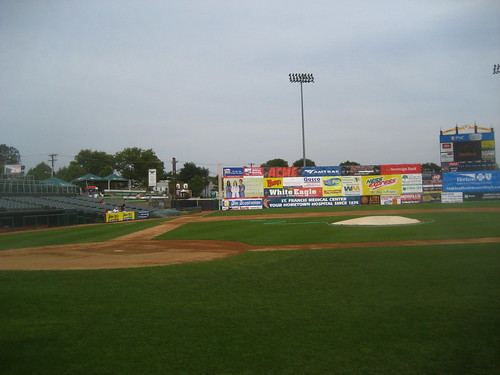
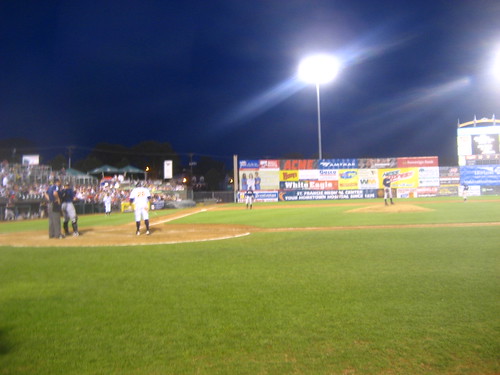
How close were we to the field? There's no zoom on this picture. NONE.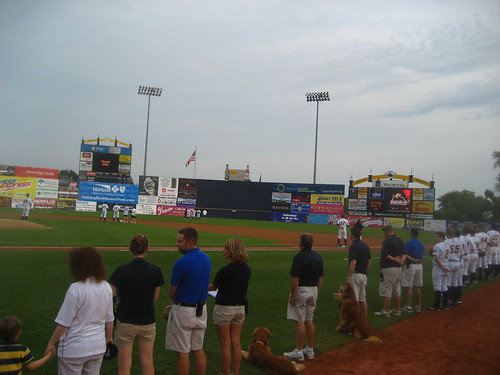
Lining up for the National Anthem.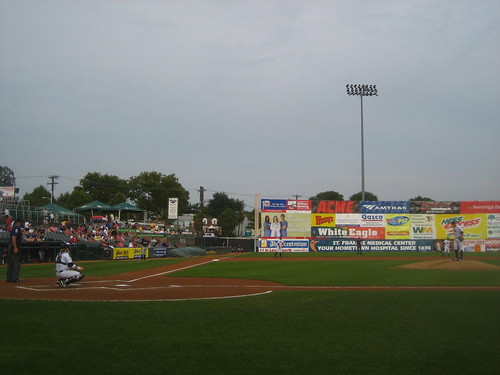
McAllister warming. His first start after coming off the DL; rumored to be limited to around 50 pitches or so.
So I used the zoom on this one, I know...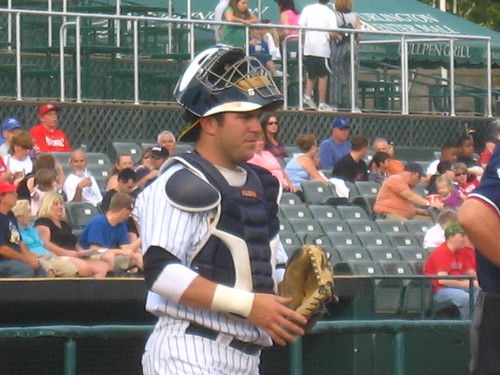
PJ Pilitterre (I know I didn't spell that right. It's late and I'm too tired to look).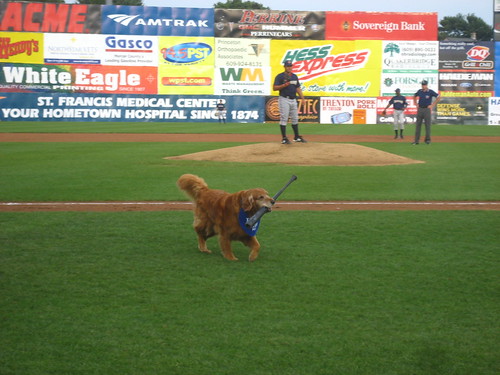
Yes, the dog is carrying the bat back to the dugout.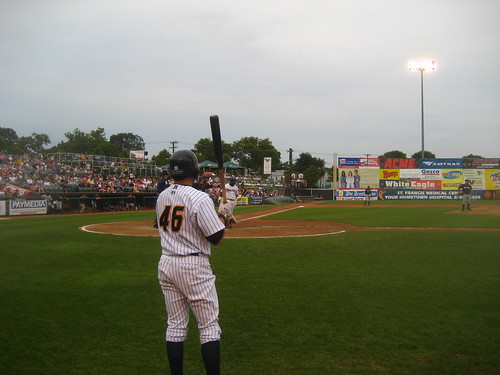
We didn't actually talk to any of the players, but one came right up to the fence, leaned against it, nearly invaded Brent's personal space and...said nothing.
Another kept giving us weird looks when Stefanie and I started talking about our favorite at bat music.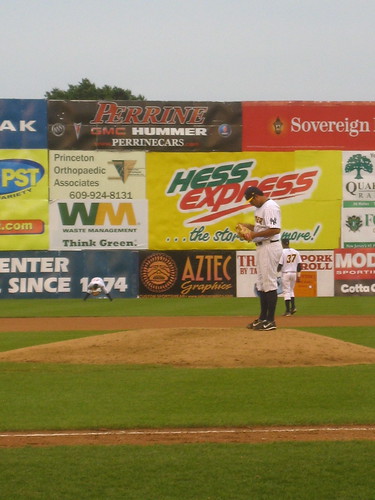
Reliever and spot-starter Kanekoa Texeira. He came over in the Nick Swisher deal, and has probably the coolest name of anyone not named Jesus.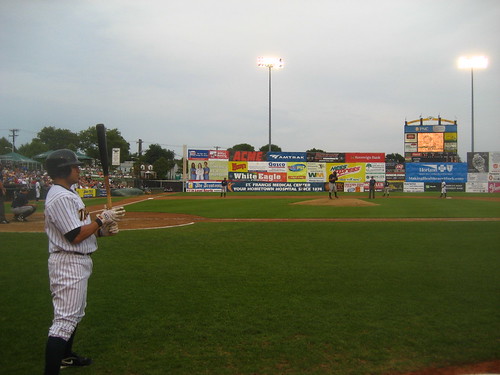
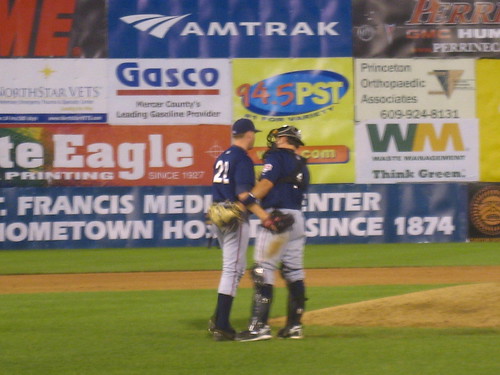
Bromance, dude, bromance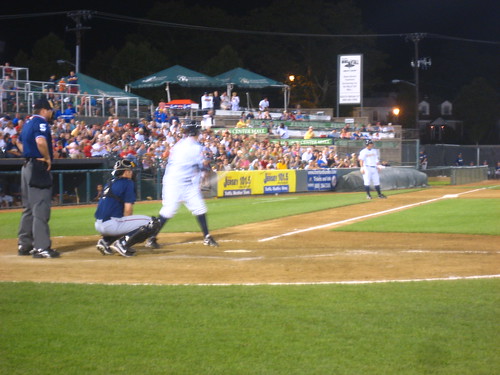
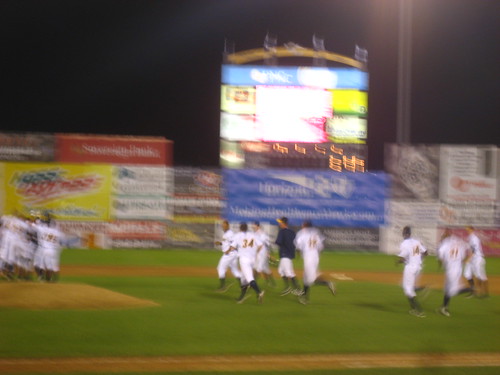
Trenton had a walk-off win in game one. Chris Malec. He does it fairly often; it's like he caught the disease from the big boys' club.
Sunday, August 9, 2009
Feel the Thunder (or some such)


Tuesday, August 4, 2009
How I discovered that I could throw a knuckleball for a strike
Two nights ago, my friend Brent suggested getting tickets to tonight's Brooklyn Cyclones game because of a Darryl Strawberry bobblehead giveaway.
Being me, I said yes, because, hey, it's baseball and an excuse not to do more important things.
We took the long D train ride all the way down to Coney Island, headed over to Keyspan Park and sat through the first couple of innings of Short Season A ball.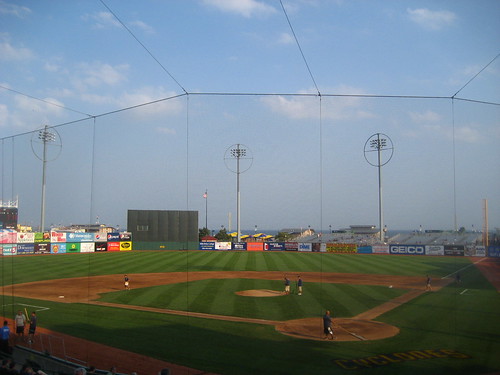
Let me tell you, in that first inning, the Cyclones played both like an affiliate of the New York Mets and like a class A team.
After a while, we got a little tired, not so much of the game itself, but the summer camp sitting next to us. Lots of kids. Lots of very, very LOUD kids. So we decided to get up and walk around.
The cool thing about Keyspan Park is that part of the park--or at least part of it accessible via the same ramp that leads to the bleachers--is a separate turf field. It's got two soccer goals and a home plate and mound area, still outlined in chalk.
So Brent, who came prepared with a glove and a baseball, and I did the only thing one could possibly do in those circumstances: We took turns pitching and catching.
I tried every grip I knew: two-seamer, curveball and knuckleball. The only one that was a strike on a consistent basis was the knuckleball, but don't let me fool you. The fastest I've ever thrown a pitch is 30 MPH, and even pitching from a flat mound that was probably closer to 50 feet from home plate than 60 feet 6 inches, there were quite a few pitches that came, well, uh, short.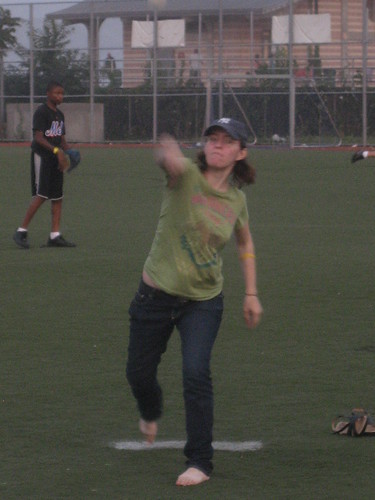
My pitching form is only slightly less embarrassing than my batting stance, which really doesn't say much...
In other words, please, please, please don't ask me to throw out the first pitch any time soon...
At any rate, we stayed there, switching on and off for about an hour.
My one, real shining moment came when Brent was attempting a side-arm delivery. After quite a few pitches that were nowhere near the strike zone, I was sort of joking, sort of not when I blurted, "you're throwing across your body too much. More arm, less body."
Strangely, the advice worked--the next three throws were all strikes.
Still, on that field I realized something: this is something every minor league park should have. While it would be unfeasible for a major league park to do so, the idea that one can go immediately from watching a game, to playing it, to watching again tugs at the very heartstrings of what this game is about.
After darkness fell and it became impractical to continue, Brent and I ended up exiting the ballpark to take in some delights of the Coney Island pier at night.
Oh, and for what it's worth, some dude on the Hudson Valley Renegades hit a home run that took out the video board in left field.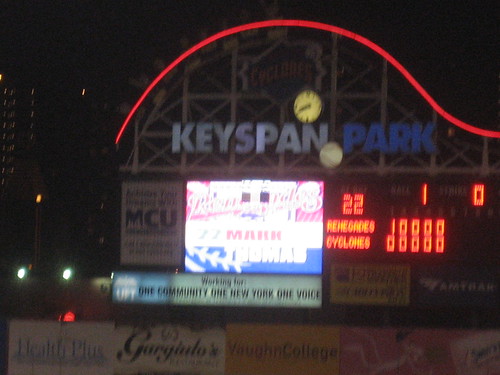
Thursday, July 16, 2009
A deceptively simple cause for Joba's problems
Tonight, I appeared as a guest on Steve Keane's Pro Baseball Central show on BlogTalkRadio.
Through much arguing and bickering about the importance of the eighth inning and what will happen when Mariano Rivera's contract expires, there was a point raised that I found worthy of further investigation:
Among the many reasons cited for Joba Chamberlains's inconsistency and lack of stamina, I have not yet seen someone tackle the issue of whether or not Chamberlain's lack of innings pitched--both in college and in the minor leagues--and the affect that might have on him now.
If you look here, you can see Chamberlain's innings totals for both his time in Nebraska and his time with the Yankees.
What do you notice?
Chamberlain did not even pitch 100 innings in the minor leagues; at Nebraska he did not reach 120 innings.
This season, he's already logged 89 innings--and if we keep the Verducci Effect (the idea that excess increases in innings pitched from year to year substantially increases injury risk) in mind, he probably won't top 130 IP--perhaps 140 if the Yankees are feeling like living on the edge with a pitcher who sustained a can't-be-overlooked shoulder injury last season.
How does this compare with others?
Roy Halladay, since he's topical, pitched about 640 innings in the minor leagues; with about 150 or so (if my random mental math is accurate) after his first call up to the major leagues.
Dan Haren pitched 472 innings in the minors; about 128 of them coming after his first call-up to the majors.
Justin Verlander pitched only 118 innings in the minors (over one season), but preceded that with three straight 100+ innings pitched seasons in college ball--Chamberlain only had two years at Nebraska and only pitched more than 100 innings in his first season.
Johan Santana pitched 340 innings in the minors; some after his first call up but the majority before.
Notice a pattern here?
It would seem, then, that there is perhaps a case to be made for "Joba hasn't pitched enough" as a reason for his depleted stamina--which in turn means lower velocity, more hittable pitches and shortened outings.
Now, there are some things to consider:
1) Chamberlain was injured in college--which is part of the reason he fell to the Yankees as low as he did in the draft.
2) He was rushed through the minors because he had been pitching so well--and also because the 2007 Yankees needed pitching help like, uh, (pick your own grossly inappropriate comparison)
3) Going from 89 innings pitched in 2006 at Nebraska to 112 innings pitched in 2007 for the Yankees at multiple levels was a 23 inning increase--perhaps not the Verduccian 30, but for a guy coming off an injury, probably close enough. I'm not sure how many innings pitched he was on pace for before he got hurt in 2008, but it's probably safe to assume that again the Yankees would have been toying with the Verducci line.
Now, already at 89 innings pitched, it doesn't seem likely that Chamberlain will be able to pitch himself out of August without really risking damage, which, of course, would create a whole other set of problems--but you knew this already.
At the time, back in 2007, I don't remember there being too much debate about Chamberlain being rushed--the team's needs were that desperate at the time. In the off-season, Chamberlain was hailed as untouchable by the fans when discussing Santana rumors, but no one--or nearly no one--suggested Chamberlain be sent back down to the minors to build up arm strength, even though the conversion from reliever to starter would surely require that.
It is--perhaps in some sick sense--almost amusing that an issue we as fans (and even writers) have seen as so complicated and so mysterious might actually be really simple: he hasn't pitched enough.
Unfortunately, I'm not sure how you'd address that situation. We're already at a point in the season in which even if you did send Chamberlain back to the minors to work on his pitches, he's pitched so many innings that it's hard to see exactly how beneficial it might be.
It's certainly, however, a warning sign--if the Yankees did trade Chamberlain for Halladay and Toronto did have Chamberlain pitch substantial innings in the minors to build up arm strength and stamina (given Toronto's history in developing--or, as it were, not-- pitchers, they'd probably take this to the other extreme), Chamberlain could yet end up being the effective starter the Yankees hoped for in the first place.
What it seems we're seeing now, then, is all the development and growing pains that should be happening at the minor league level--only it's not at the minor leagues; it's at the majors, where the hitters (excluding those on the Royals, Padres and Mets) don't let mistakes go unpunished.
Thursday, July 2, 2009
Holy Jesus Montero!
His name is Jesus Montero. He's 19 years old and was recently promoted to AA Trenton, where he's done nothing but mash.
You may have heard of him.
Without question he is the best hitting--especially power hitting--prospect the Yankees have in the minors.
There is no guarantee that Montero can keep hitting as he is, or that he will make it in the Majors, but what is clear is that he is outperforming some of the game's best when they were at that level.
What I've done in this post, then, is taken some of the game's best hitters today and in the past decade, and given you their lines for both their age-19 seasons and their first AA seasons (since most players are not 19 at AA). And then I'll give you Jesus' line, through 19 games.
Albert Pujols
Without question, Pujols is the best hitter in the game today. He's already got 30 HR before the All Star break, and with the caveat that smart teams don't pitch to him because he has almost 0 protection in the line up.
Pujols is an interesting case because he broke into stateside professional baseball at age 20--wherein he advanced from A- to AAA, and outright skipped AA altogether.
For the year, across all three levels, his totals were .314/.378/.543/.920 with, as you might imagine, most of the damage coming at low-A where he hit .324/.389/.565/.953. He played over 100 games at low-A; 21 at high-A and 3 at AAA.
Miguel Cabrera
In the 07-08 off season, the trade that sent Cabrera to Detroit (along with Dontrelle Willis) in exchange for Cameron Maybin and Andrew Miller was hailed as the biggest of the off season (until some dude named Santana went to the Mets). There's never been a question about Cabrera's bat; the question over his defense seems to have been solved by moving him from third to first.
At his age-19 season, Cabrera was at high-A, and over 124 games put together a line of .274/.333/.421/.754, with 9 HR, 38 walks and 85 strikeouts.
At AA the nest year, at age-20, over 69 games, Cabrera seems to have stumbled onto a miracle cereal, or something--at level where many bats go to die, Cabrera blossomed to .365/.429/.609/1.038, with 10 HR, only 49 strikeouts and 31 walks.
He skipped AAA entirely.
Hanley Ramirez
Often considered the #1 fantasy player in the game, because he hits well, and unlike Pujols, doesn't have an injury history.
He seems to have taken a course that is more common for some of the game's top prospects.
At age 19 in the Sally League, in 111 games, Ramirez hit .275/.327/.403/.730 with 8 HRs, 73 strikeouts and 32 walks.
His age 20 season was spent in three different leagues, ultimately ending at AA; his age 21 season was spent entirely at AA.
At that season, age 21 at AA, Ramirez hit over a course of 122 games, .271/.335/.385/.720, with 6 HR, 62 strikeouts and 39 walks.
Like Cabrera before him, he skipped AAA entirely.
Mike Piazza
As a power-hitting catcher who didn't catch very well, Piazza could be Montero's best comparison--although Piazza didn't break into even the minors until his age-20 season.
He was already 23 when he first appeared at AA ball, and over 31 games, he hit .377/.441/.658/1.099, with 7 HR, 18 strikeouts and 13 walks. The stats are astounding...and may explain why he didn't stay at AA for very long; I am inclined to think that age here is also a factor.
Andruw Jones
Never mind the sudden falling-off-the-face-of-the-earth; Jones did some crazy good things in his prime.
In his age-19 season, Jones made it all the way from high-A to AAA, so as an age comparison he probably works best with Montero.
At age-19 and in AA, over 38 games, Jones hit .369/.432/.675/1.107 (Holy $#$@#$), with 12 HR, 34 strikeouts and 17 walks.
So what about Jesus Montero?
At age 19, over the course of 19 games thus far, Montero's hit .319/.395/.542/.937, with 4 HR (12 for the year over all) with nine walks and only six strikeouts.
So, right now, Montero isn't hitting like Jones hit in AA, but unlike Jones and everyone else on the list, he has more walks than strikeouts. Last year, there was huge split, with 83 strikeouts to 37 walks; the gap has narrowed at each level, and it will be interesting to see if he can keep it up.
Nineteen games is a very small sample size, but four home runs over this time period is about one HR every five games--and this is in a pitcher's league, in a pitcher's park.
What makes Montero all the more impressive is that he is doing all of this, and he doesn't even turn 20 until November.
Now, Montero isn't a perfect prospect--he doesn't play great defense, and he, like many catchers, is slo-o-ow, but with a bat that can mash like his can, you end up pretty willing to deal with that.
One thing I've noticed--these players all seem to play only part of a season at a certain level or skip a level entirely.
Could Montero skip AAA?
It's unlikely--even if his bat is major league ready at the end of this season (unlikely, but you never know), his defense will hold him back. A hitter that good you can find a role for, especially in the AL, but with what will soon be a glut at DH, the Yankees would be best served by finding a position--any position--that Montero can play even remotely competently in the field. Catching would be the first choice--since that will give him the most value, but there are also rumors of left field. First base would seem almost natural, but as long as Teixeira's there for the next 8 years, Montero would be blocked at that position.
Still, Montero has been incredibly fun to follow thus far, and shows little sign of slowing.
Thursday, May 21, 2009
Meanwhile, Down on the Farm
Shelley Duncan, via Twitter (@shelldunc) provides this picture of the team bus headed up to Pawtucket. They've been on the road all day.
Now, that is one empty bus!
I wonder if the guys in rookie ball and short season have to take school buses...
Monday, April 27, 2009
The Big, Bad Yankee Problem No One's Talking about...yet
This weekend's sweep in Boston left many of the Yankees' immediate weaknesses exposed:
A beat up bullpen
A phantom in center field
A big bad black hole of doom at the bottom of the line up
Starting pitching that didn't so much pitch as throw the ball somewhere in the vicinity of home plate, and prayed.
Yet, these problems are, when you think about it, not necessarily all that bad.
When Alex Rodriguez returns from the line up, it should take care of the big bad black hole of doom at the bottom of the line up.
If Cashman wanted, he could probably sign Mike Cameron for a reasonable amount and receive an upgrade over Melky and Gardner in center field.
The bullpen's a mess because Bruney's hurt, though this should be a relatively minor injury, and Mark Melancon certainly impressed tonight. When the starters start giving more innings, the bullpen will be in much better shape.
There's no reason the starting pitching can't get its act together, either. Power pitchers-and the Yanks have three in their rotation-can take a while to heat up. We all know how CC struggled last April.
These problems exist, and frustrate, but they are not the end of the world.
However, the Yankees do have a much bigger issue to contend with, and it only takes a little digging to see what it is.
Derek Jeter's contract is up in 2010--the end of next season.
This, itself, is a big enough problem already.
Jeter's power declined enough last season that many fans considered him a GIDP machine, and they weren't the only one. This season, except when Girardi has opted to play both Gardner and Cabrera, Jeter has hit lead-off, to avoid the DPs.
He is showing more power this season, early though it is, than he did last season, but there is no guarantee that it will last.
What's more, no team has ever won a World Series with a starting shortstop aged 35 or older.
Then, of course, there's Jeter's defense, which, Andrew Fletcher of Scott Proctor's Arm has generously described as "past a diving Jeter"...
Now, imagine for a moment that the Yankees are not playing sentimental, that they are thinking long term and elect not to resign Jeter, or not to resign him for any longer than one year.
Guess what wonderful task the Yankees are then faced with?
Replacing Derek Jeter.
So, if you're Yankee management, which of these kids would you want replacing Jeter?
Straight from the Baseball America 2009 Prospect Handbook
Carmen Angelini? He's #1 on the depth chart. Good, right? Well, he's playing for low-A Charleston right now and has made an error in all but three games this season. It's gone from amusing, to worrying, to worrying and vaguely amusing. Angelini's still young-born in 1988-but even Jesus Montero was not this much of a defensive ornamental fountain last year.
Garrison Lassiter? He's #2, and also at Low A. He's putting together a nice average...but I repeat: he's at Low A.
Eduardo Nuñez is at AA, and is hitting .258. The season's still young and anything can happen-kid is still young-but someone hitting .258 at AA does not a Derek Jeter replacement portend.
Fourth on the depth chart is the guy currently wasting away on the Yankee bench: Ramiro Peña. Peña's certainly got the glove for the position, but unless he starts playing every day, his bat won't get the chance to develop like it should. For the moment, he's the most likable of all the guys listed here.
Now, I should be very clear about this: there is no replacing Derek Jeter.
Jeter's the guy whose name you utter when you are talking Yankee greats: Ruth, Gehrig, DiMaggio, Berra, Mantle, Mattingly, Jeter.
They may-I repeat MAY-one day replace his production, and they can certainly replace his defense, but in terms of other intangibles, it's not possible.
So in that regard, the Yankees would be foolish if they were trying to find someone that can replace Jeter as Captain.
They still, however, need to replace Jeter as shortstop and right now the options aren't too appealing.
Granted, it's still early and the young guys have a lot of developing left to do.
The Yankees could decide to use some of their overstocked pitching talent to pursue a trade, but any other GM worth his (or her) salt will probably up the price considerably.
The Yankees could sign a free agent. The list is here. It's not a very promising list. Most teams will do anything to keep their SS worth their salt since it's such a thin position. José Reyes is probably the best on the list and he's a franchise player for the Mets.
The Yankees could-and probably will-resign Jeter, though that might be their worst option. If his glove won't play at shortstop, the only other realistic option is DH-which his bat can't really carry in the American League, especially if the other option is (and it probably will be) Jorge Posada.
For 2009 at least, Jeter remains the Yankee shortstop and the Yankee captain, but while possible heirs to Mariano Rivera (Mark Melancon), Jorge Posada (Jesus Montero/Austin Romine) and Andy Pettitte (Joba Chamberlain/Phil Hughes/Take your pick) are at least beginning to emerge from the shadows, Jeter's situation is much murkier.
If the Yankees do not already have a plan in place for November 2010, they need to figure one oout.
The sooner, the better.