The common refrain going around the Yankee fan base right now is that while nothing is guaranteed, and that the Yankees are not guaranteed to win their series against the Twins, there is a different feel around this year's squad than there has been in many years. This team is likable, fun to root for and really, really damned good.
So nevermind CC Sabathia's less than stellar postseason ERA or Alex Rodriguez's absence of a decent postseason since the ALCS of 2004.
This is a team where expectations are not just high for the free agents signees who make more in a year than some entire countries, but for those who have played only for the Yankees and those who came to the Yankees in unheralded trades. The team won 103 games in the regular season, and one or two players can't win 103 games all on their own. Though, God knows Albert Pujols tried.
As with any beginning, there are opening ceremonies of a sort. With the ALDS it's nothing too spectacular--full line ups and guys in uniform, but it's somewhat muted. It's good to be here, but there's still a while to go before the grand prize.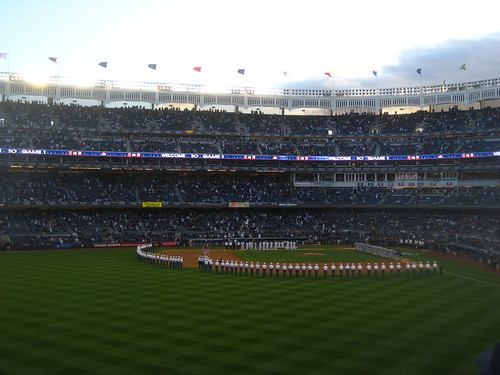
When the players are introduced, some receive particularly loud accolades--like Mariano Rivera and Derek Jeter--while others receive, well, lots of non-accolades. Like Carl Pavano.
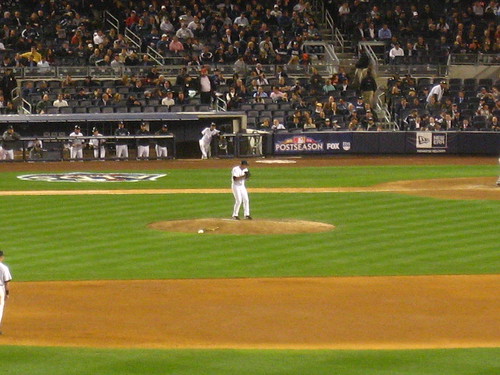
Because of the odd start time, the Stadium was still fairly empty as the lineups were being announced.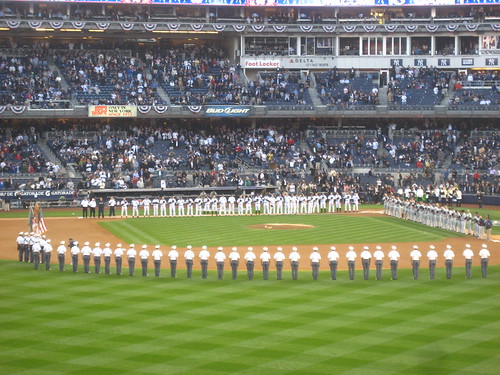
By the time the first pitch was thrown, however, almost every seat was filled.
The National Anthem always seems to add a sense of "this is it, this is what we live for."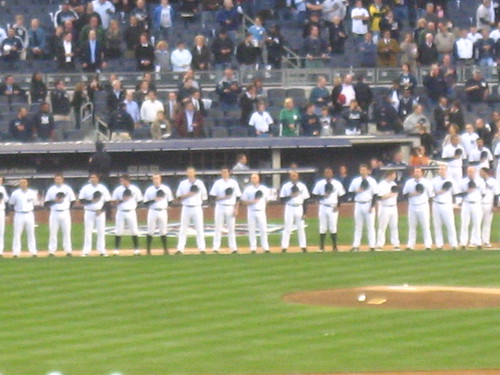
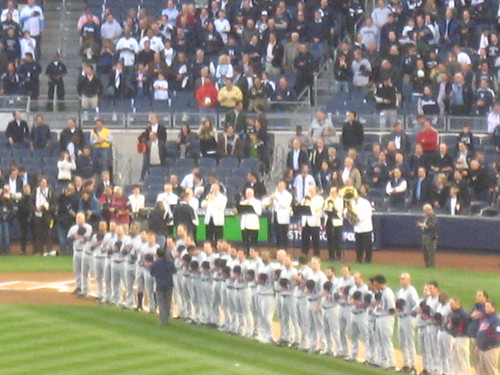
As the Yankees take the field, there is a rush of excitement. As stated earlier, if you're a fan at that Stadium at that time, you're either way amped up, or you're dead.
With no other game going on at the present moment, the scoreboard instead displays the line up of both teams, highlighting the next batter to come to bat.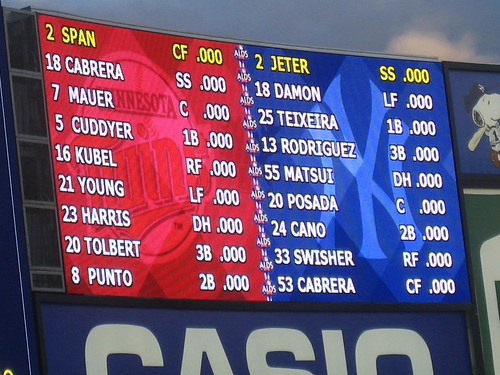
The blazing lights against the sunset make for an auspicious early game atmosphere.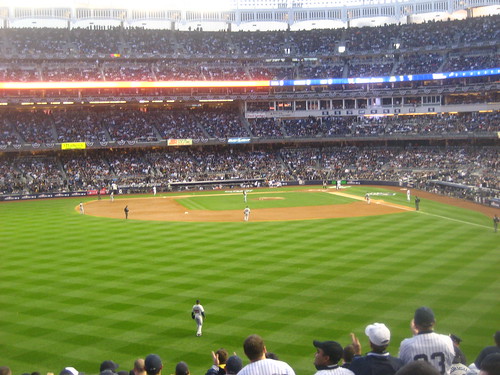
The Twins took an early 2-0 lead that could have never have been: had a close pitch been called a strike three, CC Sabathia would have gotten out of the inning. Instead, a couple hits and a passed ball, and the Twins had a 2-0 lead.
That lead was, however, short lived.
Reason A: Derek Jeter
Jeter has done a lot of great things in his career and is something of an immortal among Yankee fans. Hitting a left field home run to tie a game? Awesome. And in the postseason? Well, there's only one Derek Jeter.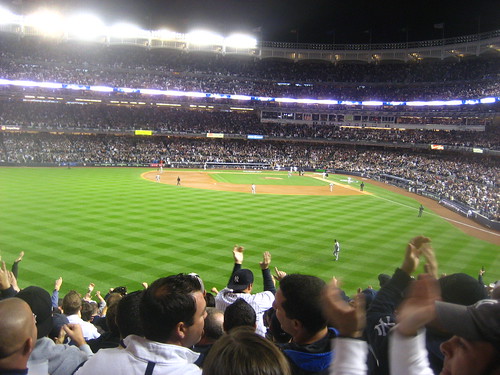
Hit a home run like that, then hear the entire Stadium erupt in chants of M-V-P! M-V-P! (Yes, we know it's going to Mauer. No, we don't care.)
Meanwhile, Sabathia must have been somewhat mindful of his rapidly escalating pitch count: he settled down and started to deal.
Despite having over 70 pitches after the fourth inning, Sabathia pitched into the seventh inning and did not walk a single batter.
The Twins were the first to go to their bullpen--by this time the Yankees had already taken the lead.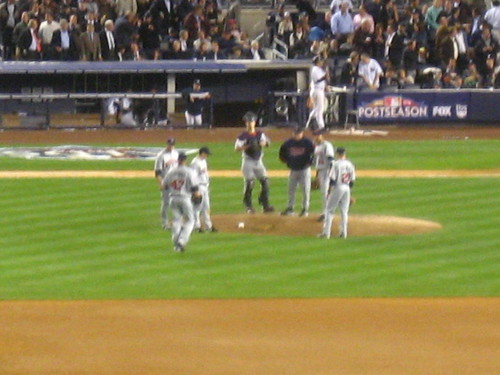
Who did the Twins call upon?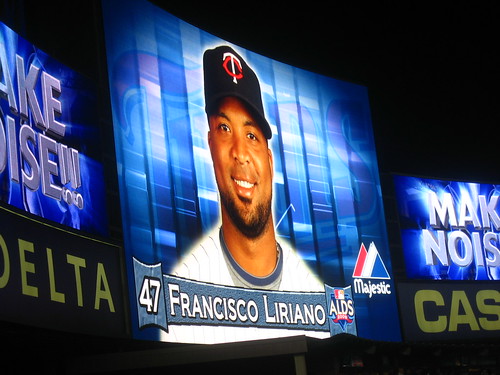
I swear I'm not making this up.
Not too long afterwards, Hideki Matsui hit a home run--the type that screams HEY YAY INSURANCE RUNS! My friend Brent summed up our reactions pretty well.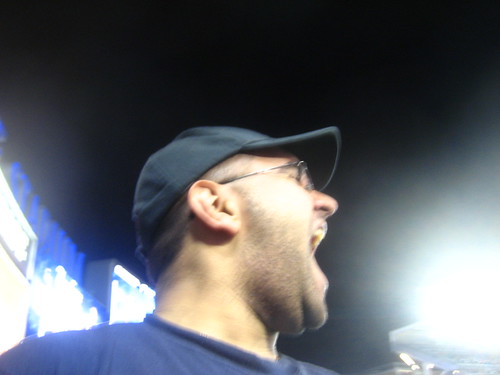
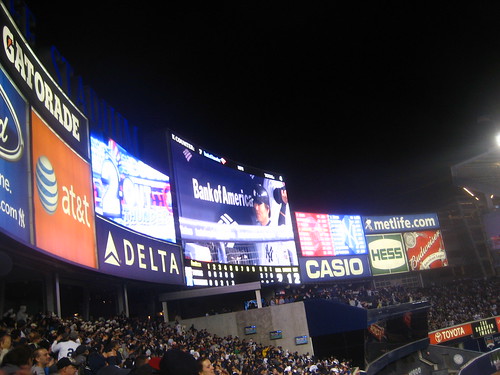
With two outs in the seventh inning and the Yankees with a four run lead, Joe Girardi did the prudent thing and went to the bullpen before Sabathia's pitch count approached abusive levels. He left to a raucous ovation.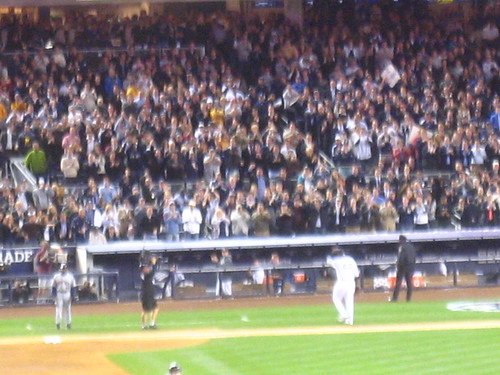
In came Young Master Hughes.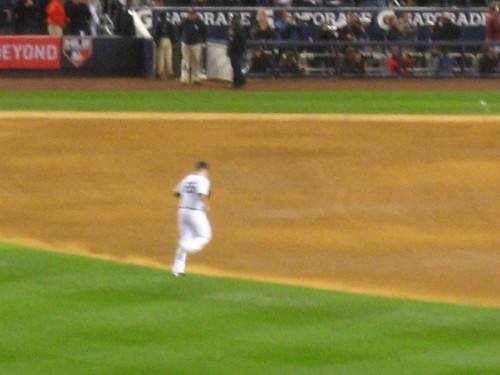
There was a massive Orlando Cabrera at bat just to end the seventh inning, but Hughes got the job done, and instead of having to face Joe Mauer with the bases loaded, Joe Mauer came up in the 8th with no one on.
This is the only game I've ever been to where I've actually heard people sing "God Bless America".
It was a stirring rendition courtesy of the NY Pops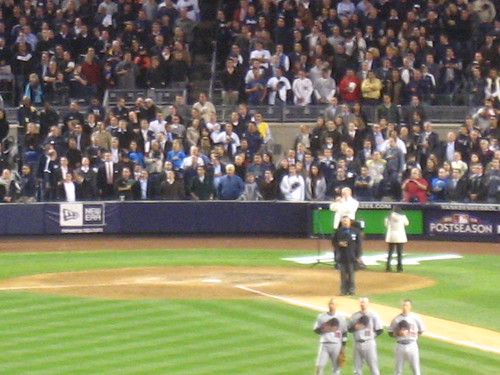
This is just a really awesome late-game shot: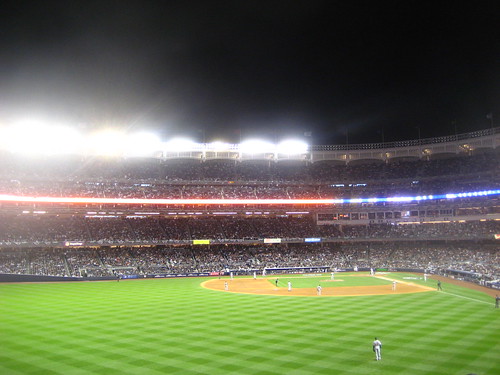
Out went Phil Hughes, and in came Joba Chamberlain. Phil Coke also made an appearance and had the best possible appearance for a reliever: one pitch, one out. It was nearly a double play, but Mauer was just a shade too nimble for Teixeira.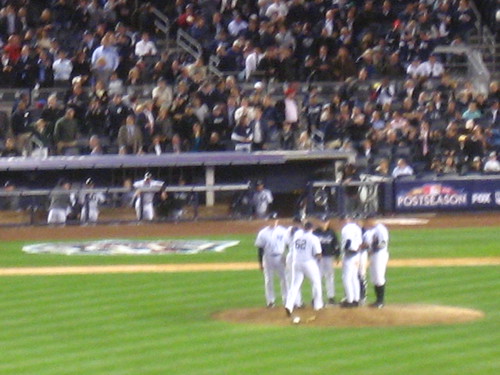
With a five run lead--and here it should be noted that two of these runs, yes two are the direct responsibility of Alex Rodriguez, something you haven't seen in an October write up for a while--it perhaps seems strange that the Yankees bring in their closer, but this is October. You don't take chances.
Enter Sandman. Exit Twins.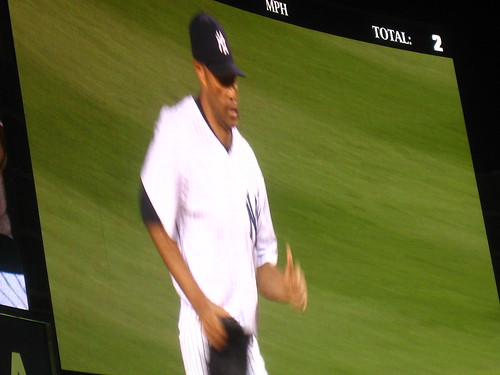
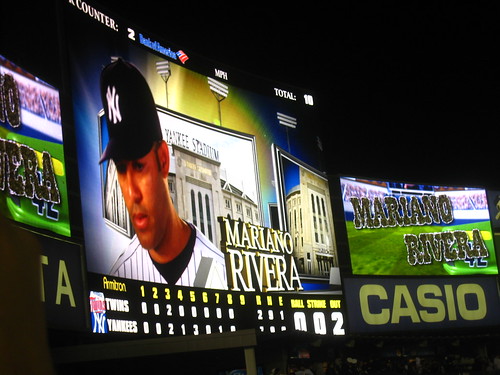
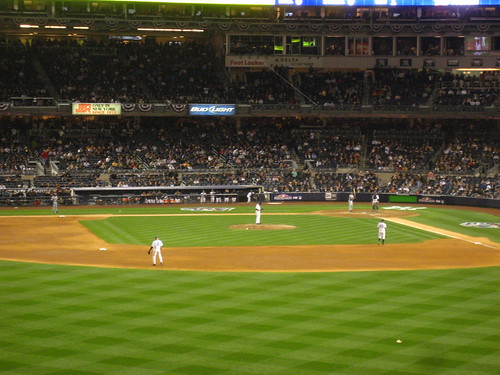
Magic number, that real magic number that all Yankee fans really care about, is now down to ten.
And we'll see you Friday night!
Wednesday, October 7, 2009
Ghosts? What ghosts?


Monday, August 10, 2009
How Joe Girardi outmanaged Terry Francona
Managers, believe it or not, have less influence on a game's outcome than you'd think. Even so, it's still possible for managers to lose jobs based on one bad decision--Grady Little in 2003 may be the most notorious modern example.
This weekend, the Yankees sweeping the Red Sox had, for the most part, less to do with the managers than it does the Yankee offense in game one and starting pitching the rest of the time.
However, there were two clear instances in which Girardi managed (in my mind, anyway) better than Francona--and it may have cost Terry Francona both games.
1) Friday
Scoreless ties are both easy and hard to manage.
The easy part is that you can just let your starter pitch, at least into the seventh inning.
The hard part comes when the scoreless tie goes into extra innings. Which relievers do you use? Do you go by conventional baseball wisdom, in which you pitch your closer at home but not on the road? How much faith do you have in your offense?
Once the game reached the bottom of the ninth inning, Francona and Girardi employed two distinct strategies:
Joe Girardi used his relievers as long as it was reasonable to do so. Mariano Rivera pitched the ninth--conventional wisdom at work here--, but Girardi didn't push him for the 10th. Instead, Girardi called on long man Alfredo Aceves who was spectacular for three innings. Given that Aceves has been sore of late, even three innings may have been pushing it a tad, and there was no question of a fourth, so Girardi went next to Brian Bruney. Bruney has struggled of late, but on Friday night he was stellar in the first inning so Girardi brought him out for a nail-biting second. Coke was used in the top of the fifteenth, and all told the Yankees managed to stay away from David Robertson, Mark Melancon and did not overuse Phil Hughes.
Terry Francona decided, instead of using his relievers for multiple innings, used more for shorter stints. For the relievers like Hideki Okajima and Daniel Bard, this might not have been a bad thing--they are, after all, short relievers, but it did mean that more relievers had to be used--and the Red Sox, apparently, don't have a true long man in their bullpen. It meant that in the fifteenth inning Junichi Tazawa was making his Major League debut in a spot where he was probably destined to fail. A starter, in the fifteenth inning, at Yankee Stadium...ycch.
Does this have more to do with bullpen construction--Girardi had Aceves, Francona didn't--or how the two managed? In this case, the most likely explanation is that the former led to the latter. The game was, after all, important enough for Francona to use Papelbon while the game was still tied, which goes against the grain of conventional wisdom.
Still, one has to wonder if it would have been possible for any of Boston's other relievers to pitch even just an extra out or two--and thus not have to resort to the last man in the bullpen.
2) The second instance came in last night's game. Twofold.
A: Joe Girardi used Phil Coke for two reasons:
1) Phil Hughes had pitched four games out of five. This has less to do with total innings pitched or pitches thrown than it does the process of getting into a game--getting hot, as it's called--is exertion itself. Even the great Mariano doesn't pitch five games out of six, except in the postseason.
2) If the game--a one run game at the time went into extra innings, the Yankees needed to save the pitchers, like Chad Gaudin, that could pitch multiple innings, and as long as the game was close, Mariano Rivera was probably going to pitch the ninth.
The two-run home run to Victor Martinez stung for a number of reasons, but Coke, the lefty, would be who you want pitching to Martinez, who has far better numbers against righties.
After the home run, it should be remembered, Coke did induce a double play to end the inning.
B: In the bottom of the inning, Daniel Bard got two quick outs for Boston, and then gave up the solo home run to Johnny Damon. After Damon's home run, then, one has to consider why Francona did not bring in Okajima to pitch to Mark Teixeira. Okajima--along with Papelbon--had been warming in the bullpen, and it may have made some sense to have Teixeira batting from the other side.
It could, of course, simply be that the events unfolded too fast for Francona to think about it much, but then Francona still left Bard in to face Rodriguez and Posada--who both reached base. At that point Francona went to Okajima, but it could be argued that by then the damage had done.
Of course, some of the blame here should be on the relievers themselves. Bard and Okajima didn't get the job done and spotted the Yankees four runs and a bat-around inning all after two outs.
This is not to say that Girardi has not made bad decisions, or that it's not a heck of a lot easier to manage when your team is winning, but these moments stand out.
There's a much different feeling in NY this morning if it's a 2-2 split and not a 4-0 sweep.
Sunday, August 9, 2009
Boston Sweep Party
If there was any question, any doubt, any uncertainty about the character of the 2009 New York Yankees, this weekend it was answered.
Oh, was it answered.
All the talk, all the rumors that the Yankees could not beat decent teams, that they were a bully team that could only beat up on teams like the Mets and the Orioles, all the insinuations that Alex Rodriguez couldn't hit in the clutch, all of it has gone for naught.
The Yankees came into the weekend set with the Red Sox needing to win one--just one--to ensure they woke up on Monday morning still in first place, and to get the 0-fer off their backs.
So they won the first game.
It wasn't pretty, a 13-6 slugfest in which the Yankees walked twelve of the Red Sox, but it counts.
After winning the first game, the rhetoric turned to winning the second. Win the second game and ensure a split, ensure that no matter what there is no net loss in the standings. Win and get AJ Burnett's own Boston monkey off his back.
So they won the second game.
It was pretty--a thing of baseball beauty--until it went too long, well into the early morning hours. Eventually, Joe Girardi out-managed Terry Francona's bullpen strategy; while Girardi maximized the relievers he did use in extra innings, Francona opted for one-inning stints and eventually Junichi Tazawa made his Major League debut, and Alex Rodriguez was waiting.
After winning the second game, the rhetoric turned to winning the third. Win the third game and ensure a net gain in the standings. Win the third game and ensure a series victory in a series in which most would have been satisfied with a split.
So they won the third game.
It was pretty, too. The pitching was pretty--more, actually, like domination than pretty--and with a starter like CC Sabathia on the mound, domination seems a better term to describe it. The offense scored early enough and the team never looked back. It wasn't a 15-0 thrashing, but the way the Red Sox had been hitting, it might as well have been.
After winning the third game, then, the rhetoric turned to winning the fourth game.
To a sweep.
No one wanted to utter that word before--too much attached to it, it might too quickly act as a jinx--but now, three wins already down, the fans (and, one senses, the Yankees) smelled blood in the water.
The match up, on paper, favored Boston. Jon Lester, in his career, is (still) undefeated against the Yankees, although he has not always won.
Tonight, Lester wasn't much different. He made only one mistake--a solo home run to Alex Rodriguez--in seven innings of work. That the Red Sox were held scoreless, too, had less to do with Andy Pettitte (though it must be said that Pettitte got much stronger in his last two innings of work) than it did the Red Sox offense, which has simply disappeared.
Between the ninth inning of Thursday's game and the eighth inning of tonight's, the Red Sox did not score a single run. Thirty-one-and-a-third scoreless innings. Blame Boston's offense or laud Yankee pitching, it's your choice, but the fact remains that in four games against their rivals the Red Sox scored eight runs and four of those came before the fifth inning on Friday.
If there was one blemish tonight, it was Phil Coke giving up a two-run home run to Victor Martinez, but Girardi's reasoning for using Coke in that spot was sound: Phil Hughes was unavailable after pitching four games out of five, and if the game got to extra innings, the Yankees needed pitchers available who could give length.
During the postgame interview on YES, Coke explained that the pitch to Martinez was supposed to be up near his hands, and not down by his thighs. He was angry about it, and then was not angry anymore once the Yankees won. "So much for 8-0," he said.
Johnny Damon and Mark Teixeira were there to bail Coke out, though, with back-to-back home runs in the next half inning. In fact, while with two outs, the Yankees would proceed to bat around in the inning.
So the Yankees won the fourth game.
They won the fourth game and swept the Boston Red Sox.
Had they swept this series against any other team it would be noted for the stellar pitching, clutch hitting, brilliant defense and everything else that went right. Since the series was against the Red Sox, though, it'll be remembered, rightly or wrongly, mostly for being a sweep of the Red Sox.
The Yankees are now 6.5 games in first place--the first time since 2006. It's still early, and there's still a long way to go, but there it is.
This is a team that is not just playing like it could, but playing like it will go on to do special things.
They can't get complacent now. They have to keep going. This has the feeling right now that the Yankees have just clinched the division. They have not, and with a month and a half to go it's not really that close, either.
Look for some of the regulars to get a day of rest while playing Seattle--after that it's back to the West Coast and then Boston again the weekend after.
For the moment, enjoy what you've seen.
And so much for Boston being 8-0, huh?
Friday, July 31, 2009
Don't Blame This One on Andy
Andy Pettitte, since the All Star Break:
20 IP, 16 H, 7 R, 6 ER, 23 K, 3 BB (Yes, that's 23 strikeouts to three walks over twenty innings pitched).
In those starts, he's also received a grand total of three runs of support.
The Yankees have scored more runs than any other team in baseball, but apparently Pettitte did some sort of voodoo curse on the bats because they are very much not scoring for him.
It's a shame, because Pettitte has been stellar since the break, and even if he isn't exactly the Andy Pettitte of the late 1990s, he's certainly pitching well enough to be 3-0 in his last three starts, and not 0-0, with the Yankees having lost two of those games.
*****
It's tempting to blame the loss on Phil Coke, but Coke didn't put that runner on second, Hughes did. To be fair, Hughes was probably a bit gasses, and Girardi remains afraid to use Rivera in a tie game on a road.
At any rate, if you're going to blame anyone for this game, blame the offense that struck out seven times looking.
If the home plate umpire has a strike zone the size of a small state, you should probably at least swing at anything remotely close.
Some of you will consider this loss more grating than the game Sabathia recently lost; I disagree. Most nights if you get an effort from your starting pitcher like Pettitte gave, your team will win.
Wednesday, July 15, 2009
Breaking Down the Yankees for the Second Half - The Bullpen
[So the All Star Game is officially over--and we can thus consider ourselves in the second half.
This is where it gets fun.
All of those days players got rested in the first half? Well, now they have to play. Now the pennant races start to heat up, and every move a team makes, be it a trade, a free agent signing or simply bringing someone up from AAA has even more added meaning.
What do we expect from the Yankees?
I'm going to do a series of posts addressing this, because there's so much to say that having it all in one post would a) kill your eyes and mine, and b) give me carpal tunnel at the age of 23.]
Since this is the last post in the series, I'll provide you with an index:
The Rotation
The Lineup, Part 1
The Lineup, Part 2
The Bench
Now it's on to the mother of all things Yankees:
The Bullpen
To do this post justice, one has to figure out who should be included, and who might be a little more expendable--since bullpens are fluid and change so much over the course of a season.
In this instance I'm going to settle around the "core" of Mariano Rivera, Alfredo Aceves, Phil Coke, Phil Hughes, Brian Bruney, David Robertson and Brett Tomko--the guys that have been around (or should have been around) all season. Mark Melancon and Jonathan Albaladejo will get passing nods, but we'll go ahead and pretend that Jose Veras and Edwar Ramirez were not utterly awful.
As a whole, the bullpen struggled early--when most of the rotation did, as well--but the call-up of Alfredo Aceves seemed to work miracles. That one move allowed for the short relievers to remain short relievers, for Coke and Hughes to basically claim the eighth between them and for Robertson and Tomko not to be faced with undue pressure.
When Aceves was moved from the bullpen for a spot start, we saw the 'pen fall apart again--though, this time, fortunately, the All Star break came at exactly the right time.
As long as Joba Chamberlain and Andy Pettitte are utterly ineffective, look for Aceves to remain in the bullpen.
(The so-called bullpen core in alphabetical order)
Alfredo Aceves
The statistics will tell you that Alex Rodriguez, and not Alfredo Aceves is the more valuable of the two Yankees to make their first appearance this season in early May, but Aceves' value lies in far more than just the numbers he's posted.
The easiest way to explain what Aceves has meant to the Yankees in 2009 out of the bullpen would be to say that Aceves is pitching in a role similar to that of Ramiro Mendoza, but his numbers out of the bullpen are actually closer to what Mariano Rivera posted in 1996.
Since Aceves can pitch multiple innings at a time without getting worn down, the short relievers--especially guys like Phil Coke and David Robertson--do not have to pitch nearly as much as they otherwise would. This not only saves their arms from, uh, being Proctor'd, but helps keep them more effective over the long haul.
Look for Aceves to remain in the bullpen for now--after the disaster in Anaheim, the Yankees probably don't want to mess with the bullpen too much--but if Mitre, the presumed new fifth starter, bombs and the Yankees decide not to go after Halladay (or another, you know, more attainable starter), Aceves could end up the fifth starter.
In which case we will all have to hold our breath in the second halves of games started by Chamberlain and Pettitte.
Brian Bruney
The season that, for Bruney, started with so much promise has quietly turned into a disaster. He'd earned himself the eighth inning role before going down on the DL with an elbow problem, worked his way back only to go back on it after just one appearance, and now seems to have lost the command that had been so important in the first place.
In short, it's the return of the 2007 version of Brian Bruney.
The Yankees really want to get him right--if he can somehow recover his arm strength and command, the Yankees could consider, more seriously, the idea of sending Hughes down to AAA to stretch him out as a starter (although I explain here why I don't think it would work), but even if Bruney did recover, the risk inherent in relying on a power pitcher who's twice been on the DL in the same season with elbow problems is an enormous one.
It's a shame, really, because Bruney showed so much promise in 2008 before hurting his foot, and then again in early 2009.
I don't know what happened for Bruney to have such awful karma, but something apparently did.
Going forward, Bruney will likely be used in low-leverage situations until his command improves, or he will be used in mop-up like roles after the starters (yet again) are inefficient. He'll have to work his way back to the 8th and even then there is no guarantee.
Phil Coke
The battle between Good Coke and Bad Coke may be as addicting to watch as the battle between Good Melky and Bad Melky. Actually, the entire reason to want to see him pitch is to watch the postgame interviews afterward.
Coke struggled in the beginning, found a groove, and then struggled again in his most recent appearance in Anaheim.
On the whole, he's been fairly dependable, but tends to give up too many hits--6 HR in 38 IP is not a portent for good things to come--so the Yankees are best served if he is used very sparingly, which, thanks to Aceves and Hughes, he now is.
Should Dámaso Marte stop playing catch and start playing baseball, he could help ease some of Coke's LOOGY duties, and provide some relief for the Yankees, who are playing with fire.
Phil Hughes
Probably the most controversial reliever, not because he's pitched poorly, but because he probably should have never been in the bullpen in the first place.
As a starter, Hughes wasn't exactly dominating anywhere outside of Texas, but he was getting better, and showing improved consistency and efficiency. Considering that this is his first healthy season since all the way back in 2006, that's not something to be taken lightly.
As a reliever, Hughes has just dominated. You can see the splits here, but to sum:
Hughes' ERA is 0.98, his BAA is .115, OBPA is .182 and WHIP is 0.655.
Hughes has only pitched 18.1 innings in relief, and his BABIP is an insane .147, so there's certainly a case to be made that the law of averages will catch up to him, but with relievers much of the time, you only have a small sample size to use, so you ride the hot arm as long as it stays hot.
If the Yankees have learned only one thing here, it's that if Hughes, for whatever reason, loses his value as a starter next season, he still has plenty of value as a reliever.
Look for him to keep the 8th inning role in the second half unless the Yankees have utterly no choice but to stretch him out again. If that happens, than the Yankees will probably have bigger issues than what they do about the eighth inning...
Mariano Rivera
He's Mo. Really.
He was getting hit more often in the beginning of the season, which had some worried, but this seems to have been a result of recovering from off-season shoulder surgery and perception, since what he did last season was simply historic.
He's back to his old Mo self now, notching his 500th save and 1st career ERA in the same game.
In the second half, the Yankees probably won't want anything more than for him to keep doing his thing. Wearing number 42, he is, after all, the answer to Life, the Universe, and Everything.
David Robertson
The easiest way to explain Robertson in this: when he throws strikes, he's unhittable. When he doesn't, he's unwatchable.
When Robertson comes into a game in low-leverage situations, he throws strikes.
When Robertson comes into a game in high-leverage situations, he throws balls.
You can see why this is a problem.
In a mop-up type role, Robertson is fine for the bullpen, but the problem is that the Yankees play a lot more close games than they do blowouts, and they need relievers that can either protect a lead or keep another team's lead within reach.
Look for him to stick to low-leverage situations, and don't be shocked if some combination of Chien Ming Wang getting healthy again and Sergio Mitre pitching well sends him back on the AAA bus--though likely not before Melancon or Albaladejo.
Brett Tomko
The problem with Tomko is that when he gets hit, he gets hit hard.
Though a former starter, right now he can't really pitch more than two innings at a time, and he's seldom seen in anything other than a mop-up role or in an extra inning game when all other pitchers have been used.
That said, I think he does get a bit of a bum rap--for what it's worth, Coke has given up more home runs. Then again, Coke's pitched 38 innings and Tomko's only pitched 20...
Although Tomko is a DFA candidate, it would seem more likely that Mark Melancon or Jonathan Albaladejo would be sent back down to Scranton before the Yankees parted ways with Tomko. We shall see.
Mark Melancon and Jonathan Albaladejo
Melancon, once hailed as the future Mo, was probably called up from AAA Scranton too soon. He's struggled in AAA since being sent back down, and again since being called up. There's too much talent to write him off, but he does need some more time.
Albaladejo didn't pitch well early and got sent down, has pitched lights out when recalled after Wang got hurt the second time, but then got sent back down...to make room for Melancon.
If Girardi is riding the hot reliever, right now he should stick with Albaladejo.
dude, if you made it this far, I kind of want to hug you...
Monday, June 8, 2009
Bombers Bomb and get their Phil from the Bullpen (Postgame Notes 08 June 2009)
When Andy Pettitte's pitch count shot up past 70 in the fourth inning, there wasn't much question that the Yankees had the perfect opportunity to get Phil Hughes some much needed work from the bullpen.
Pettitte ended up staying in for six innings (and striking out seven along the way; the first six in the first three innings), but in the top of the seventh Phil Hughes came in, and Phil Hughes threw gas.
At the time the Yankees had a one run lead, and Hughes pitched out of the bullpen perhaps even better than his 2007 ALDS performance, though, granted, the stakes tonight were a bit lower.
No doubt, those who tune into WFAN tomorrow will likely hear a litany of "Hughes to the bullpen" phone calls, but the fallacies of that argument are for another day.
Still, Hughes was not to be outdone.
Phil Coke came out for the 8th, and other than one walk, also threw gas. A tremendous outing for him given his struggles on Saturday.
Mariano Rivera had another 1-2-3; he's probably unavailable to pitch tomorrow, but, it should be noted, the weather forecast for Boston tomorrow is something awful, so the game might not even be played.
The Yankees scored all their runs today via the home run: Mark Teixeira, Nick Swisher, Johnny Damon and Darek Jeter, with Swisher's being a two-run shot. Teixeira's and Swisher's were out in any park, and even Damon's and Jeter's were out in most parks.
The only knock was that the Yankees could not sustain a rally, but I'm not sure they're worried about that right now--when they got their hits, they made them count.
Hideki Matsui, 0-his last-16 could probably use a day off.
Saturday, June 6, 2009
Witness to a Loss (Postgame Notes 06 June 2007)
"Take that shirt off, they lost today!" A middle-aged man shouts it from the passenger seat of a car while I am crossing 3rd Ave, walking back from the subway to my apartment.
"I know," I say, "I was there."
I was there to see CC struggle in the middle innings, to see David Price allow only two hits, to see Rivera falter, Coke implode and BJ Upton's reach be just long enough to end the game, and quash a rally.
I was there, to see, in the ninth inning, as a foul ball knocked out a young girl and made everyone who could see it--those in the area and those sitting immediately above--forget about the game.
Did Mo know it happened?
If he did, it might explain why he couldn't pitch through the ninth. Alas, I have my doubts that such was the case.
Rivera struggled against the Rays in a tied game in the beginning of May, so while it doesn't excuse it, it might help to explain it.
Much is being made of the decision to take CC out of the game after eight, but I never thought much of it. I'm not sure if it was the right or the wrong decision, because it wasn't as though the Yankees were going for the ninth inning with Jose Veras or David Robertson. Still, you have to balance that with Mo's struggles this year, and you end up playing games of what-if-this and what-if-that.
The only real knock on the Yankee offense today was Alex Rodriguez and Jorge Posada being unable to even reach base in the ninth, though to his credit Posada did battle.
The Yanks' couldn't hit Price well, but looked as though they were running wild against the Rays' bullpen. Teixeira's jack bounced off the wall on the luxury suite level--utterly no question about it.
Ah well.
Tomorrow's another day.
Sunday, May 31, 2009
Screw Baseball Logic. Rivera Should Have Been Pitching (postgame notes 31 May 2009)
Conventional baseball wisdom is a funny thing.
Conventional baseball wisdom states that in a tie game, on the road, you don't pitch your closer beccause there's always the chance that your team will take the lead and you will need someone to pitch the bottom of that inning.
Conventional baseball wisdom, however, also assumes a few things.
It assumes that the rest of your pitching staff is functional and that your other relievers won't have an issue throwing strikes.
It makes the assumption that everything is playing exactly as it should play.
As you might imagine, the problem with this is that this scenario rarely occurs.
Case in point: today's Yankees' game.
Going into the bottom of the ninth in a tie game, the best pitcher the Yankees had left in their bullpen was their closer, Mariano Rivera.
Now, if the Yankees didn't want to pitch Rivera to start the inning, that's one thing, but once Phil Coke gave up the lead off walk and that runner reached scoring position, the move to go to the unreliably wild David Robertson over Mariano Rivera is baffling once you disregard conventional wisdom.
Even if the Yankees take the lead the next inning, it's not as though Rivera's never pitched two innings before...and while it's understandable that you might not want Mo to pitch two innings, surely then you're more comfortable throwing Robertson or Aceves or whomever out there with the lead than in a tie game while Rivera sits unused.
Having worked exactly once since last Sunday, it's hardly like Rivera's been overtaxed.
Sometimes the best managers are the ones who take conventional logic, and then precede to say, "screw it".
*****
Otherwise, the game was nothing to get too upset about--Carl Pavano pitched well, but the Yankees struck when Wedge took him out of the game. Teixeira had all four Yankee RBI; Hughes had one bad inning in the third and it kept him from pitching more than five, though he wasn't awful and the game never got out of hand.
Yankees will have a chance to take the series tomorrow evening.
Saturday, May 23, 2009
A-Rod and Melkman Come Up Clutch; Yanks Walk Off (Postgame Notes 23 May 2009)
Earlier this afternoon, Helen and I are on the D train from Columbus Circle, going north to Fordham.
Helen has just arrived from Newcastle, England; she's not, as you imagine, a baseball fan by nature, though she is trying.
We're standing, holding onto one of the poles, it's about 4.30 pm and I can't remember now what we were talking about then, but at 125th street, a guy and a girl get on. The guy is wearing a Yankees' cap while the girl is wearing a Phillies' cap.
As one might imagine, the girl starts uttering,
"We'll be lucky if we get there by the seventh inning."
I can't help myself.
"All the good stuff happens in the later innings, anyway."
Self-fullfiling prophecy, it would seem.
I have no idea as to how Andy Pettitte pitched or as to how most of the Yankees hit; when I turned the game on, it was 4-1 Phillies.
Here is what I did see:
Phil Coke is something, that 8th inning guy if/when Bruney can't go.
Derek Jeter had a nice home run, but Alex Rodriguez hit one out in the ninth, and that one mattered, no question.
Bottom of the ninth inning, off of Brad Lidge, to tie the game...and, of course, once that happened, there really wasn't much of a question:
AJ had to go get the pie ready.
The question became not if the Yankees would win the game, but who, and it would somehow seem fitting that Melky Cabrera, who started the last winning streak, should start this one.
***
CC Sabathia and Cole Hamels tomorrow; should be quite a match up
Tuesday, May 19, 2009
Peña and Cervelli Making Most of Their Opportunity
There's one moment from tonight's game that keeps cropping up in my mind, even a couple hours after it's over.
It's in the ninth inning; there are two outs with Carlos Gomez at first in a one run game, and Phil Coke is struggling to throw strikes.
Instead of, say, Jeter and Canó heading out to the mound to calm Phil Coke, it's Francisco Cervelli and Ramiro Peña.
The two youngsters, of course, if everything goes to plan, should never have been in a major league game this year, at least, not as starters and, with the exception of Peña's late-inning glove, certainly not in the ninth inning of a one-run game with the tying run on base.
And yet, here they are, saying whatever words of wisdom they can to settle a pitcher trying for his very first major league save.
Peña and Cervelli are not, at least yet, marquee players, and they're not really expected to be. Cervelli will probably be overshadowed by either Jesus Montero or Austin Romine within a few years (or less), and Peña doesn't even rank on Baseball America's prospect radar.
Yet, here they are, and here they are playing better than anyone expected.
Neither is the automatic out they were expected to be; both do all the little things right, and both are positively beaming every time they are interviewed after the game.
While Peña will probably stay on the 25 man roster as long as Alex Rodriguez is still a little gimpy (and, face it, he inspires more confidence than Angel Berroa), the future for Cervelli is less certain after Jorge Posada and Jose Molina return. It's unlikely that the Yankees would want to carry three catchers, especially if they can send Cervelli to AAA (I doubt they send him all the way back to AA) where he can play every day. It's entirely possible that if Posada and Molina are a bit gimpy, Cervelli hops the Chris Britton express.
While they're still in New York, however, they've done everything asked of them and then some.
And they've made the team fun to watch in the process.
Monday, May 18, 2009
Yankees Bend, don't Break, win Sixth Straight and Sweep Twins (Postgame Notes 18 May 2009)
For a while, it seem scripted that the Yankees might have to settle for a fourth-straight walk off if they were going to win the game. Going into the ninth with a 7-5 lead and an unavailable Mariano Rivera, there was perhaps more tension here than in any of the walk off wins, as going to extras here would have meant blowing a one-time 6-2 lead.
Yet, with Carlos Gomez dancing off of first, Francisco Cervelli and Ramiro Peña--and not Derek Jeter--went out to the mound to calm the young Phil Coke, who like the rest of the pitching staff buckled, but never broke.
The Yankees were down 2-0 at the end of the first--Minnesota scored first every game of this series--but got to work quickly on Glen Perkins.
The first four batters all reached base and scored, thanks to home runs from Mark Teixeira and Alex Rodriguez, and Perkins was knocked out of the game in the first.
The Twins' bullpen, was, however, very effective, and slowly the Twins began to chip away. A run here, a run there, and soon enough the score was 6-4, a two run lead and only a depleted Yankees' bullpen to protect it.
Teixeira added another home run to make it 7-4, and after Edwar Ramirez served up a home run to Michael Cuddyer Denard Span, it became very clear that the extra run was needed.
It's perhaps fairly surprising that the combination of Veras and Ramirez only gave up one run, but it was quite hairy. The Twins didn't have a 1-2-3 inning all game.
The Yankees were perhaps also helped by stellar defense from Ramiro Peña, Derek Jeter, Robinson Canó and Mark Teixeira. They were making plays that I doubt Jason Giambi or a still slightly gimpy Alex Rodriguez would have made, and they loom large now.
Still, despite the hairyness, the Yankees have won six straight to get to four games over .500 for the first time this season, and Brian Bruney should return tomorrow (and Mo should be available, of course).
Mo, Bruney, Coke and Aceves is not quite an imposing bullpen core, but the four have been steady all year when healthy (or in Mo's case, all career).
CC is on the mound for the Yanks tomorrow night; the last time he pitched Baltimore, it was crack. Hopefully he can emulate the performance.
Thursday, April 30, 2009
Bottom of the Order Comes Through, Yanks finish April Above .500 First Time Since 2006 (postgame notes 30 April 2009)
Given the struggles of Chien Ming Wang, the injuries to A-Rod and Nady, the low RISP batting average and the sweep in Boston, it may be hard to believe that the Yankees have finished April above .500, but they indeed have.
At the worst, they would have finished the month at .500, and that itself would have been an improvement over the last two seasons, but they didn't just win tonight, they also beat the one team that's given them fits and starts for over a decade in the Anaheim Angels.
AJ Burnett did not have his best stuff, and occasionally looked like he was getting hit very hard, but somehow managed to make it through seven innings keeping the Yankees firmly in the game.
It was certainly not his best start of the season, but he gave the Yankees a chance to win and they took advantage.
Johnny Damon had a solo home run, furthering calls of "bandbox!", but the big offensive moment of the game came in the 8th inning.
In a tie game, Melky Cabrera's single put the Yankees ahead 5-4, and then Ramiro Peña's two-run double, his first two career RBI, put the Yankees ahead 7-4 and the team didn't look back.
Phil Coke pitched an excellent 8th inning with the game tied--it looks more and more like the early season troubles were flukes, though it's still early to tell--and Mariano Rivera bounced back and got through the ninth allowing one hit and nothing else.
I would like to caution that while it seems Rivera is getting hit more this year (and, well, he is) may seem worse than it is simply because of how dominant he was last year. He struggled in April '07 as well and managed to survive the year intact, no?
Ramiro Peña is looking more and more like should have been the placeholder at 3rd all along. He plays an excellent glove and is not an automatic out, and came through in a big place today. He should be sent back down when A-Rod comes back, because he really should play every day. He's not considered a top prospect for the Yankees, but he's taken advantage (or, at least, it seems that way) of the opportunity here.
Mark Teixeira continues to struggle; whether this is his normal early season struggles or if his wrist is hurting a bit more we don't know. He's still walking so his OBP is still up there, but the .200 average can't continue to hit in the three spot if he doesn't pick it up. It's still early and signs say he will recover, especially once A-Rod comes back.
Robbie Canó, thanks perhaps to Bobby Abreu's defense, now has a career-best 17 game hitting streak. He had an 0-fer the rest of the night, but his hit came in the 8th inning--the right time.
Sunday, April 12, 2009
Yankees Snatch Defeat from Jaws of Victory (Postgame Notes 12 April 2008)
Must be something about my birthday but the Yankees didn't win on April 12th last year, either.
Anyway, it looked like the Yankees were going to have one of their best early season wins, coming from behind to take the lead against Kansas City's number one starter, and the Yankees were one out away from getting the baseball to Mariano Rivera.
Disaster struck, however, when Joe Girardi over-managed the bottom of the eighth. After Damaso Marte got two quick outs Girardi elected to play mix-and-match, but Veras walked his lone batter and Phil Coke gave up three earned runs and a 4-3 Yankees' lead turned into a 6-4 Royals win.
Joba Chamberlain pitched six decent innings, giving up one earned run and two unearned runs. Even with a line up that included both Gardner and Melky, not to mention Molina and Ransom, and without Teixeira or Posada, the Yankees still managed to score four runs. In that respect, today's game wasn't a disaster.
It just hurts like hell when you're that close.
The Yankees head next to Tampa. The Rays lost two of three to the Orioles, but won today by a score of 11-3.
Thursday, October 2, 2008
Addicted to Coke
Something I found interesting:
Joba Chamberlain, September/October 2007
12.2 Innings Pitched
7 hits
2 runs
1 earned run
17 Strike outs
2 Walks
0.71 ERA
Phil Coke, September 2008
14.7 Innings Pitched
8 hits
1 run
1 earned run
14 strike outs
2 walks
0.61 ERA
(statistics courtesy of Baseball-Reference)
There are a few reasons that it's hard to compare Phil Coke to Joba...right?
I was going to say that first there's an age difference, but Coke is only two years older than Joba. I understand that a 25 year old player should be at a different stage developmentally than a 23 year old. Joba's the Yankees #1 prospect of 2008 according to the Baseball America handbook while Coke isn't even in the index--and he's not in Baseball Prospectus 2008 either.
Two years, however, is just two years. Phil Coke isn't a 33 year old journeyman; he's a young pitcher. Perhaps a late bloomer, maybe, but if he continues to pitch as well as he did in September, he has more of his career ahead of him, rather than less.
The expectations on Joba are, of course, much different than those on Coke. Joba's expected to anchor a rotation in the future. Coke is...well, not.
If you get past that, for a second, think about the different situations in which the two broke in at the major league level.
When Joba broke in, it was after blazing through four levels of the minors in one season, and in the middle of a pennant race in which the Yankees still had realistic hope of not just winning the Wild Card but also winning the division.
When Phil Coke broke in, the Yankees had been realistically eliminated from the division and more or less eliminated from the Wild Card as well. the pressure, and indeed, the expectations on him were completley different
Coke has, of course, opened many eyes--and if the Yankees have noticed, so has everyone else.
You're not supposed to judge players based on September performances, but, alas, for Coke, that's all we have to go on.
This is what you like to see, as a baseball fan--the unheralded player, one that might even be a prospect, opening eyes and drawing much interest. Now there are questions as to whether Coke should be a starter, and depending on whether or not the Yankees land a big Free Agent starter, Coke might find himself talked about in February and March as being a part of the rotation.
Is Coke better than Joba?
Over the long run, probably not--Joba has better 'pure stuff', but every time you try to think of a reason that Joba and Coke don't compare, you find either that they do, or that there's a plausible excuse as to why not.
Joba has pitched in pressure situations.
Coke's never seen October, but he pitched quite effectively in the Final Game, which more or less had the same amount of must-win pressure (even if the season at that point had been lost, that one game was, of course, a must-win).
Joba's strike out numbers are much higher, but then, so are his innings, and when you take a look at comparative innings, the numbers are similar.
Joba can throw it 100. Coke finished the season at 96.
Joba's family life makes for a great story. Coke...well, nearly getting cut from the team in Spring Training is a story in its own right.
Joba has a cool name. You can make drug puns with Coke's.
It's very possible that next season Coke comes back to earth and ends up as a solid, if not spectacular left-handed pitcher out of the bullpen--and thus a very valuable commodity.
Yet there still remains the possibility--funny, ironic, whatever--that Coke ends up finding himself of more value to the 2009 Yankees than Ian Kennedy or Phil Hughes.
How many of us still remember he was almost dealt in the Nady/Marte deal? Were the Yankees, perhaps, on to something when they decided not to trade him? Did Pittsburgh miss something in preferring Karstens and McCutcheon? Time will tell.
We will be watching him with great interest.
Monday, September 1, 2008
It's a Hitting Holiday (Postgame Notes 1 September 2008)
There's that old saying again--they don't have to be pretty, they just have to be wins.
Such was the case today.
Unfortunately, while the good ole' slugfest was fun to watch, for a while, it may be a case of too little, too late.
Losing two out of three to Boston was bad enough, but two out of three to Toronto as well was a dagger--and I had the honor of seeing the 7-6 loss on Saturday in person.
As far as today's game went, however, one has to wonder where this offense has been the entire season. Games like today were games the Yankees were supposed to have in spades this year, and they simply have not.
This game would have fit in nicely last year, with the Yankees winning in spite of their pitching staff, and not because of it (okay, Phil Coke had a very nice debut, but that was about it in terms of pitching).
The Yankees now head to Tampa for three before heading out to Seattle and Los Angeles.
Friday, July 25, 2008
An Act of Piracy?
Was it pure piracy?
We won't know for sure for a couple of years, when Jose Tàbata should be major league ready, but for now, it sure looks it.
Who the Yankees got:
Xavier Nady: Corner outfielder with pop in his bat.
Dàmaso Marte: Left-handed relief pitcher who was more or less the most sought-after relief pitcher this season.
Who the Yankees gave up:
Ross Ohlendorf: You've seen him before. Hard throwing pitcher who could turn into a starter or a reliever.
Jose Tàbata: Last year, he hit .305 with a broken bone in his wrist. This year, the youngest player at the AA level, he has had some red flags go up with his attittude when dealing with a tougher level of competition.
Phil Coke: AA pitcher who has looked stronger recently, but is already 26 years old.
George Kontos: Potential servicable #5 starter.
EDIT:
Coke and Kontos have been replaced in the deal with Jeff Karstens and Dan McCutcheon.
Jeff Karstens: Marginal starter.
Dan McCutcheon: Could turn into a very reliable bullpen arm.
So, what does this do for the Yankees?
Well, going into the trade deadline, the Yankees had three needs, viz:
1) A right handed bat, preferably one that could play the outfield corners--left field this year, while Damon's shoulder is still not 100%, and potentially right field next year, if the Yankees decline to bring back Bobby Abreu.
2) A starting pitcher to spell Darrell Rasner or Sidney Ponson.
3) A left-handed reliever.
They have now, pending physicals, filled numbers one and three on their list, and done so without giving up anyone on their twenty-five man roster, without giving up Austin Jackson, Jesus Montero or Mark Melancon, and done so while the combined cost of Nady and Marte is under $11 million.
It's hard to know exactly how everything will play out, but right now, the Yankees could be heading into the latter part of the year with a starting line up of:
Johnny Damon DH
Derek Jeter SS
Bobby Abreu RF
Alex Rodriguez 3B
Jason Giambi 1B
Robinson Canò 2B
Xavier Nady LF
Melky Cabrera CF
Jose Molina C
Sound a bit longer than the line up currently in place? Thought so.
Now think about what the bullpen might look like:
Mariano Rivera
Kyle Farnsworth
Jose Veras
Edwar Ramirez
David Robertson
Dàmaso Marte
Dan Giese (okay, so Hawkins will probably still be here, but that's not the point).
That is a formiddable bullpen.
For all of the talk of this being a rebuilding year, Brian Cashman and company have made a move that will do that much more to help this team well now.