So this is what the World Series, the real World Series, feels like, huh?
What with the pitching and the timely hitting and the Mariano-ing and the Hoosierdaddy-ing and the mid-game-change-your-luck-Tweetups with Amanda Rykoff and Brent Nycz and the OHMIG-D YOU DID NOT REALIZE PAUL O'NEILL WAS THROWING OUT THE FIRST PITCH!
This is what it feels like.
It feels pretty darn good.
This isn't just baseball.
This is love.
***
Unlike last night's cold, rainy and windy drudge, tonight felt like October baseball.
There was, first of all, getting off the subway and walking, in the pale, dying sunlight, across the street to the Stadium. There, you find yourself transported to another world, one in which nothing matters except baseball. Nothing.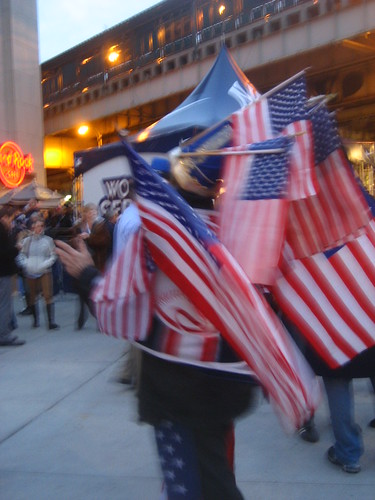

There was, in the pregame, the Jay Z/Alicia Keys mini-concert.
I'm not even a Jay Z fan, but the show the two put on seemed to set something off: the Stadium came alive, as if, finally, finally, we realized what it is our team has accomplished.


We're here, in the World Series.
We've reached the last round, we will play in the last Major League baseball game on the 2009 calendar; we will play into November.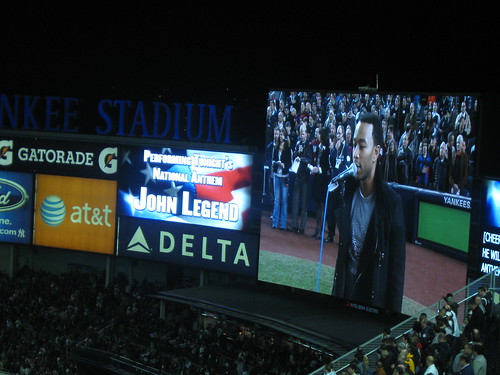

The National Anthem is sung by John Legend and there's a flyover which goes right over my head, all of which is utterly awesome and makes it hit me again: HEY THIS IS THE WORLD SERIES, but it pales in comparison to the reaction when Paul O'Neill comes out to throw out the first pitch.
We are ready for this game to start.
AJ Burnett takes his warm up tosses not to the 300 soundtrack as normal, but instead to Marilyn Manson.
I don't know if today will be Good AJ or Bad AJ, not yet, but the music choice soothes me: almost every other time I've seen Burnett pitch this season with his normal warm up music, he's been bombed. Maybe the change will do him good.


After a few innings, after the Phillies take a 1-0 lead and Pedro Martinez refuses to let the Yankees do anything besides chant "Who's Your Dad-dy?", Amanda Rykoff and I start texting. She's scored a last second ticket to the game and we're talking about a mid-game tweet-up, along with Brent Nycz, to change the Yankees' luck. We decide: Top of the fourth inning, by section 413.
So, we meet and we walk over to one of the concession stands so I can buy myself some Twizzlers.
We watch the game on the screens, which are about 10 seconds behind the actual play on the field.
We watch AJ Burnett pitch a 1-2-3 inning, and then we watch Mark Teixeira hit a game-tying home run into the Yankees' bullpen, and we decree the tweet-up a success: our luck has been changed.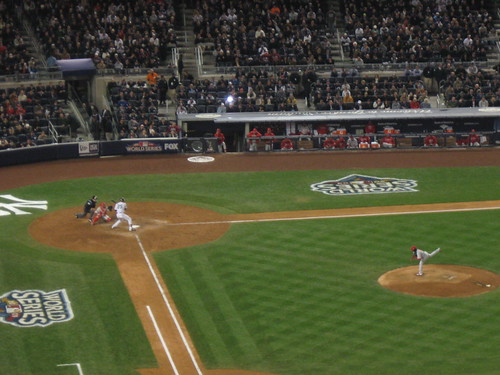
After we part, Burnett pitches as though he has taken it to another level. Slowly, we stop holding our breath with every pitch AJ throws, and instead begin to long for the next one. It may not be Lee's dominance, but you could have fooled us.
In the seventh inning, the crowd senses that this is something spectacular. So we chant: "AJ! AJ! AJ!"
He dazzles.
Later on, while speaking to reporters, he'll say it's "the funnest I've ever had".
In the bottom of the seventh, with a one run lead, the Yankees threaten for more. With first and third and no one out, a Melky Cabrera singles makes the score 3-1 and knocks Pedro Martinez from the game. Hoosierdaddy!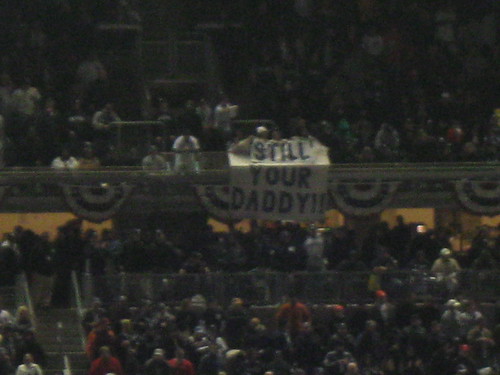

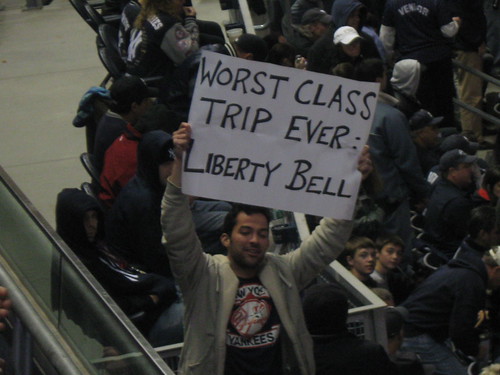
After a pinch-hitting Jorge Posada reaches, Derek Jeter bunts foul ("I was stupid", he is rumored to have said) and Johnny Damon comes to the plate.
I'll examine this in more detail tomorrow, but from our seats, what we saw was him ground to Ryan Howard, who, without touching first, threw the ball wide of second base. It should have left the Yankees with the bases loaded and no one out, but it was instead ruled a double play.
Somehow, you get the feeling, that it's impossible to conduct a 2009 postseason game without some sort of major umpiring scandal.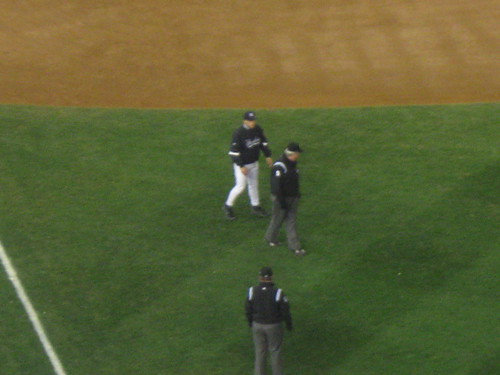
Still, the umpires' awful call notwithstanding, the Yankees took no chances, and went straight to Enter Sandman.
With the top of the Phillies' lineup due up in the eighth inning, going to Mariano Rivera is, in terms of, leverage-baby-leverage, a no-brainer. With the off day tomorrow, the Yankees could afford to do it, and so they did.
Rivera did make things a little exciting, but, being the great Mariano, he found a way.
Ball game over, Yankees win, theeeee Yankees win!
****
I found and purchased a "Got Pie" t-shirt. It's a much better souvenir than the program, which cost $5 more than normal and is mostly a reprint of the LCS program.
I still can't get over the umpires' call in the bottom of the 7th. I will address tomorrow, likely in the afternoon.
Any photo taken after the fourth inning is credit Brent Nycz. The video of the final out (will be uploaded in morning) is credit Amanda Rykoff.
Friday, October 30, 2009
"The Funnest I've Ever Had"


Monday, October 26, 2009
Leverage, baby, Leverage
When Mariano Rivera began to warm in the seventh inning last night, there were a variety of reactions. Some liked the move, some did not, and I admit that, at first, I was a little worried--what if something happened, Rivera pitched two innings, the Yankees lost the game and then Rivera wasn't able to pitch a Game Seven?
Fortunately, I soon came to my senses, and remembered that I do believe in the concept of use-the-best-reliever-in-highest-leverage, as this is exactly what Girardi did last night.
In the top of the eighth inning, in a game that was still a two-run score, Girardi went with his best reliever to get the top--and then the meat--of the Angels' batting order: Figgins-Abreu-Hunter-Guerrerro-Morales.
Just as recently as Game 5, Phil Hughes struggled against that same part of the lineup, unable to get the one out he needed, and as big a Robertson fan as I am--and I'm a big one--when you have the option to go to Rivera, you take it.
Now, according to Fangraphs, the fourth inning in which the Yankees scored their first three runs was the highest-leveraged situation of the game, but at that time the starter was still pitching, and, well, ideally you don't remove a starter in the fourth inning.
Still, as the graph indicates, the leverage situation in the eighth inning was still much higher than that in the ninth.
The Yankees, last night, employed Mariano Rivera in the most effective way that they could. How is the mood repaying them?
The team's off to their fortieth World Series.
****
Stay tuned for more World Series/Turnpike Series goodies. I've got somehwere to be this afternoon, but plan on a Live Chat Tuesday evening, round 7.30. I will post a reminder tomorrow.
Anything is Possible
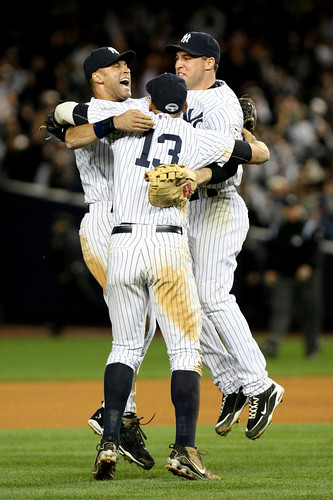
(photo credit: Nick Laham/Getty Images)
I had forgotten what it felt like.
Not the winning, but the euphoria.
This feeling, that nothing can touch us, that nothing can stop us, that for this moment, the baseball gods have smiled.
The Yankees, though, the Yankees were there to make sure I remembered.
***
No one said that beating the Angels would be easy, and it wasn't.
Six games, six games in which every emotion as a fan was tested: there was anxiety, nervousness, pleasure, pain, face-palming and, at long last, euphoria.
To be the champions of your league, you have to beat the best along the way.
The Angels were the only team in the league that played the Yankees well consistently all season, and so it was fitting that the road to the World Series would have to go through Anaheim.
When it came down to it, it wasn't just that the Yankees had ALCS MVP CC Sabathia and the Angels didn't, or that the Yankees had Alex Rodriguez and the Angels didn't, it was that the Yankees never forgot how to play fundamental baseball.
Fundamental errors cost the Angels games two and six; even just costing them one of those games would have been too much.
****
It is only fitting that Andy Pettitte was on the mound tonight.
He was there in 1996, he should be there again this season, when comparisons to the late nineties Yankees have been so apparent.
It was fitting, and Pettitte was vintage.
He only pitched into the seventh inning, but he kept the Angels to just one run, and you get the feeling that once the Yankees scored, the Angels never really had much of a chance.
There was Pettitte, and then there was Joba, where we held our breath, and then there was Rivera.
****
I've gone back and forth on Rivera in the eighth, but ultimately it was the right decision. As a proponent of the leverage argument, tonight's use of Rivera is exactly what should have been done, with him facing Figgins, Abreu, Hunter, Guerrerro and Morales in the the eighth inning, in a two run game.
You knew Rivera would be on the mound for the final out, regardless of the score.
It just wouldn't be right without it.
****
The work isn't done.
Philadelphia's not just a good team, they're the defending World Champions and with good reason.
Yet, you get the feeling, if anyone can beat the Phillies, these Yankees can.
We have watched this team, all season, dazzle us, surprise us, enthrall us and, most of all, make us believe.
And so we do believe.
The quest for 27 remains, and it closer than ever.
This team is showing us that they are of the Substance, that they are Yankees.
The euphoria is back.
Anything is possible.
Friday, October 23, 2009
It's all about the leverage (or why Mariano should have pitched the 7th)
Leverage is a funny word. A loaded word, if you will.
For one thing, it's more or less responsible for the financial collapse of America.
In baseball parlance, leverage refers to an on-field situation--the inning, number of outs, score, pitch count, etc--and how likely the result of that on-field situation is to have an effect on the game.
Example: Bases loaded, no one out, top of the eleventh inning as it was in game 2 of the ALDS is a high leverage situation, because the result of the next pitch (or, if you prefer, at bat) is likely to have a significant impact on the game's final outcome.
Other example: Top of the ninth inning, two outs, runner on second, your team is up 10-1. This is a low leverage situation. At this point in the game, because of the score, whatever happens with the batter at the plate is unlikely to have a significant impact on the game's final outcome.
***
With this understanding of leverage, one can put forth a very simple concept:
Teams should use their very best relievers in the highest leveraged situations.
Simple, direct, easy to understand, right?
Here's where we have a problem: there is a pervading belief among many, especially those that read only main stream media (MSM), that the highest leverage situations are automatically the ninth innings in close games. In other words, situations that would warrant a "save".
This is not necessarily the case.
The ninth inning can become a high leverage situation, but many, if not most, games are decided before the ninth inning.
In the seventh and eighth innings, for example, you are likely to encounter a situation in which the starter has been removed from the game but where most (okay, right now, all) teams will consider it too early to go to their "closer"--who is often the team's best reliever.
Take tonight's game, for example.
In the top of the seventh inning, John Lackey was (wrongly) removed for Darren Oliver with the bases loaded and two outs.
With the score only a four run differential, this was an incredibly high leverage spot, especially with Mark Teixeira and Alex Rodriguez--two power hitters--due up. Now, one can argue whether or not Brian Fuentes should be a closer, but what is clear is that Oliver is not the Angels' best reliever. Jepsen, Fuentes and Bulger are all arguably or factually better than Oliver.
So the Angels and the Yankees were left with a situation where the Yankees were batting against the "soft underbelly" of the Angels' bullpen in a close game, and a team as good as the Yankees doesn't usually miss.
It's not much of a surprise, then, that at the end of that half inning, the Yankees lead 6-4.
At that point in time, Mark Teixeira's at bat shapes up to be the single most important at bat of the game. Never mind what followed afterwards, but at that very moment, it seemed likely that Teixeira's at bat could very well dictate the final outcome of the game.
Think of it this way: if you're the Angels' skip, are you sure you pitch Oliver there? Or would you be better off, if you're determined to take Lackey out, by bringing in Bulger or Fuentes?
***
So now we come to the Yankees and the bottom of the seventh inning.
Let's start here with a couple of knowns or supposeds:
A) Mariano Rivera is the best reliever the Yankees have on staff.
A1) Right now, this is likely followed by David Robertson, Phil Hughes, Joba Chamberlain, Phil Coke, Damaso Marte, Alfredo Aceves and Chad Gaudin, with Gaudin not being used except to mop up a blow out or to pitch extended work in extra innings.
B) Pitching the ninth inning of any game is not an easy thing to do, even if it's not necessarily the highest leveraged situation of a game. Just watch this interview after Phil Coke's first Major League save:
Thus, while one tries to address leverage, one cannot ignore a ninth inning where the leading team leads by no more than three or four runs as being a non-factor.
After tonight's loss, there was much conversation about the seventh inning and what should or should not have been done.
There is no arguing that the inning was the most critical part of the game--just look at the WPA graph:
(image credit: Fangraphs)
The bars on the bottom indicate the leverage of a situation--the ninth inning ended up turning into quite the critical situation, but it doesn't matter if not for the seventh.
As it was, a simple refresher:
With a two run lead, AJ Burnett went back to the mound with 80 pitches, and the first two Angel batters quickly reached base. At this point Girardi pulled Burnett for Damaso Marte, who retired two batters while allowing one run. Marte was then pulled for Phil Hughes, and, well, we know what happened from there.
Here's the leverage argument:
Because of the importance of the situation, with the tying runs on base and the Angels' best hitters (Hunter-Guerrerro-Morales) due up, Girardi should have gone to Mariano Rivera.
It's a claim that much of the MSM and their readers/viewers will brush off as being too reactionary, but it's based on the single, simple premise discussed above:
Teams should use their very best relievers in the highest leveraged situations.
At the time, there is utterly no way to predict that the ninth inning will matter or how much it will matter.
What you know, however, is that at the time, the two potential tying runs on base are the two most important runs you want to prevent from scoring if you are the Yankees.
A tie game will automatically favor the home team, since they always have the final at bat and one less half inning to pitch, so it is imperative to keep that from occurring.
Most (okay, all) teams will use these situations for their set-up men, and this is where those like Mike Francesa start oggling over the eighth inning guys. The fallacy here is the the eighth inning guy, almost by definition of the term, is not a team's best reliever, but the team's second best reliever, the one that teams most trust to get to their best reliever.
Has your head exploded yet?
At any rate, after tonight's game, I had a conversation with Ben Kabak of River Ave Blues.
I had previously asked via Twitter how many would have pitched Mariano in the 7th, and a large number of respondents said either that they would or that they would at least think about it.
I then brought up the issue that if you pitch Mariano for the seventh and maybe the eighth, and the Yankees don't score again, you are still left with a high-leverage ninth inning in which you cannot use Mo (the Hammer of G-d is, after all, 39) and have to choose from the remaining pitching staff.
Ben proposed this solution--and I swear your head IS going to explode--
You have Andy Pettitte pitch the ninth.
It's not abnormal for a starter to pitch in relief in the playoffs.
Starters are, by definition, better than relievers, and many teams, even playoff teams, lack a solid relief corps outside their closer and maybe one other guy.
We saw Jered Weaver pitch in relief tonight; in the past we've seen Mike Mussina do it in an ALCS game 7 against the Red Sox. There are other historical examples, as well.
You don't, as Ben suggests, pitch David Robertson in the ninth in a save situation, because there is an intangible aspect to a save that can't be ignored--see the Coke video above.
You go, instead, with the experienced hand.
In this scenario you don't even need to worry about Pettitte's start on Saturday--because you've effectively used Mariano, perhaps piggybacked with Robertson in the eighth, so you still have the lead in the ninth. Pettitte grabs three outs and the ALCS is over.
I am not the first person to suggest that a reliever's most important role is the ninth inning and I doubt I'll be the last.
Some day, a manager will come to the same conclusion and pitch their closer in the seventh to get through another team's 3-4-5. If that manager succeeds, he'll be branded a hero, visionary and genius, and if he fails, he'll be branded whatever his city's equivalent of "Clueless Joe".
The beauty of baseball is that it is a game that evolves, and that someone, somewhere, will try.
Tuesday, October 20, 2009
The Legend of Mariano Rivera
The kid, no more than six or seven, sees the pitcher warming up in the bullpen.
"Is that Mariano?" He asks, his eyes wide with excitement.
"No," says the man sitting next to him. No, it's not Mo warming up in the bullpen, it's Damaso Marte.
****
One is 42, one is 43, and yet there are such different emotions attached to the two numbers.
What's the difference between 42 and 43?
What's the difference between the sun and the moon, night and day, water and land?
One enters the game and there is an air of inevitability, even when he does his job: the Yankees will lose this game, it's just a matter of when.
One enters the game and there is an air of inevitability, because he does his job: we are witnessing the Hammer of G-d.
****
In his sci-fi series, Douglas Adams humorously proposed that the number 42 is the answer to life, the universe and everything.
For the Yankees, 42 is the answer, the solution to any ailment, any ill, any misstepping reliever.
Number two might be an icon, the number most readily associated with the team, but 42 is something else entirely.
Forty-two is legend. Myth. Forty-two cannot be mortal. It cannot.
****
Forty-two has had his failures, just as the Greek gods had theirs, but the failures are noticeable only because the successes are so great.
Of the eight teams to enter the 2009 postseason, midway through the LCS, only one has not blown a save opportunity. Only one.
You have three guesses.
You'll need one.
****
There is one reason that the legend grows: he does not lose himself in it.
He does not promote himself as the Greatest of All Time; he lets others do it for him.
****
When did we know?
Have we always known?
It's grown over the years, grown to the point that we cannot imagine life without Forty Two.
Sometimes they say that the most important ballplayers are the ones that you don't think about until after they are gone, but he has transcended this.
We know he can't pitch forever, but we hope, and he teases us.
He has the greatest season of his career at an age when most athletes have already begun to break down, with an injured shoulder to boot, and he follows it with 2009, with his 500th save, first career RBI, and a flat-out magic act last night.
****
Forty-two doesn't need any Chuck Norris facts, any internet memes or doctored videos. He doesn't need the promotion.
He just does his job. No more and no less.
****
He misplays the bunt.
Going to third is the right decision on the play, the out is right there for him to take, but he slips on the grass and we groan.
We hold our breath. Any other pitcher on the mound and surely some of us would have left, but we can't leave here. All he needs is a chance. A strike out and then a double play, maybe. A broken bat grounder. If anyone can do it, he can.
Chone Figgins grounds out to first. Mark Teixeira makes the put out.
Bobby Abreu is intentionally walked to set up a force, and then Torii Hunter grounds to Teixeira who gets the out at home.
We exhale, a little. An out can't score a run. Vladimir Guerrerro grounds out.
The Stadium explodes.
In this moment, anything is possible.
The legend grows.
Mariano Rivera and the....Spitball of Doom?
SERIOUSLY?
I know thinks are whack in California, but SERIOUSLY?
The Greatest Closer of All Time, and not-quite-mortal, and you think the Panamanian is throwing a spitball?
Sheesh, dude, if you forgot, you won the game yesterday.
Yeah, I know, you won in spite of Rivera's 1st-and-3rd, no out heroics, but, dude...
I mean, this is Mariano freakin' Rivera. He could probably beat you throwing one handed. blind and throwing with his left hand. 'Scuse me, I should have been clear about that.
He don't need no spitball.
More later.
Monday, October 19, 2009
A Taste of Their Own as Angels Walk Off on Yanks
Generalizations never achieve much, but in this occasion, one generalization can explain a lot.
The Yankees lost game three of the 2009 ALCS because Joe Girardi managed a road game as if he were still home.
You can call it over-managing if you'd like--and indeed, it probably was--but managing the game the way Girardi does at home is not nearly as much of an issue as it is on the road, especially in extra innings.
1) At home, one run by your team in extras and the game is over. You don't have to worry about scoring, and then pitching again in the bottom of the inning as you do on the road.
2) On the road, one run from the other team and the game is over. Your offense doesn't get another shot.
So here's the breakdown.
1) The Yankees' biggest issue in this game--and, it's looking like their biggest issue this series--is a lack of hitting with runners on base. Every Yankee run today was via a solo home run, and while the Yankees have had decent enough pitching to win when they score four runs much of the time, much is not all. The Yankees had golden opportunities to add to their lead, and they did not. Andy Pettitte made one bad pitch, and well, boom. A 3-1 cushion is not a big cushion, at all.
2) I don't have an issue with leaving Pettitte in to face Guerrerro although I admit that, since I did not have a computer handy, I don't know what his pitch count was at the time. My issue is with the pitch Pettitte threw: there was no reason, in that situation, to give Guerrerro anything to hit. Guerrerro swings at, well, everything. Sabathia and Burnett can blow it by the former Expo; Pettitte cannot.
3) Chamberlain looked awful. Girardi was quick with his hook, but, alas, not quick enough. Someone--and I can't remember where I read this, so apologies to whomever I should be citing--said that this postseason, Joba's fastball has been there but his slider has not, which may explain why he's been hooked quickly.
The great thing about going to games with well-informed fans is that you get excellent analysis as well, and I thus agree with the commenter known as TSJC: Joba tends to overthrow, as though he is too amped and trying to do too much. It's been an issue with him as long as he's been with the Yankees.
4) I did not agree with Girardi's decision to leave Hughes in to start a third inning. Hughes hasn't pitched more than two since what, June? May? And against the heart of the Angels' order, as well, it just didn't make sense to me. Girardi thus made the right call to bring in Rivera, and, well, Mo is simply not mortal.
First and third, no one out, and Rivera got out of the jam. At the time, the Stadium exploded and we thought it was perhaps destiny that we'd win.
5) The biggest issue I had with Girardi's overmanaging was bringing in Aceves to face Kendrick. Robertson had already had two outs, had little history vs Kendrick (if any at all) and is a strike out pitcher. Aceves, on the other hand, has a propensity for giving up fly balls, and as we all saw, the ball certainly carried today. At home, if the other team hits a home run, you still get a chance to get the run back the next day, but on the road, you do not.
As it were, Kendrick singled and Mathis drove him in with a long fly off the wall, but it is my belief that Robertson could have gotten the third out.
6) TSJC had an issue with Girardi replacing Damon with Hairston, not that he did it but when he did it. With the bases loaded and less than two outs, anything hit to left field is likely going to score the winning run, anyway. It makes little sense.
7) If Gardner is inserted into the game to pinch run, he has to run. He has to go on the first pitch--where there's pretty much no chance of a pitch out. Gardner's not in there to hit home runs, and the only reason to remove Matsui's bat is because you are going for the win right then, and need the RISP. If Gardner steals successfully, Posada's home run is a game winning, and not game tying (fallacy of the predetermined and all).
8) GOOD: Jeter's third pitch home run, holy crap what is A-Rod smoking and where can I get some, that Melky-Jeter-Teixeira play in the 8th to nab Abreu (where the heck was Canó on that? We were trying to figure it out!) Mariano is not mortal, and Teixeira is (again) worth it for his defense alone.
Okay. I think I touched on most of the important things. You can argue whether or not Sabathia should have pinch hit for Rivera instead of Cervelli, but there is no way Rivera was going to go out and pitch a second inning.
If Andy Pettitte pitches to Guerrerro a little differently, the Yankees are probably looking at clinching the American League pennant tomorrow and Girardi's overmanaging is a non-issue.
Such as it is, the Yankees will send CC Sabathia out on three days' rest, and a stop-loss here would be crucial.
We said going in that this series would be a dogfight, and with two extra inning games already in the books, it has thus far lived up to its billing.
Sunday, October 18, 2009
Fundamentals 2, Angels 0
Fundamentals. Fun-duh-MEN-tuls. Noun. 1) Something that is part of the foundation of another thing. 2) In sports, the key concepts that must be mastered before attempting advanced work.
Example: A fundamental concept of baseball is the ability to correctly catch and throw a baseball.
Example 2: Another fundamental concept of baseball is that when one's team takes the lead, that team is supposed to keep the other team from scoring.
Were the New York Yankees fundamentally sound tonight? No, not really--they had three errors in the game.
The difference, however, is that while the Yankees worked around their fundamental mishaps, the Angels did not.
Sure, AJ Burnett's wild pitch that led to the Angels tying the game at 2 could be considered an error if you'd like, but that was more typical bad-inning-AJ than it was poor fundamental play on the part of the Yankees.
On the other hand, the Angels' second error of the game directly caused the Yankees to score the winning run, a ground ball that should have gone for the sure out that went instead sailing past the target and allowing Jerry Hairston Jr. to score.
It won't be cast as an error, but attention should also be paid to the game tying home run Alex Rodriguez had in the eleventh inning.
From the Yankees' point of view, their third baseman has been the unequivocal MVP of the postseason thus far (though there is obviously a lot of way left to go). Rodriguez has hit three home runs this postseason, and every single one of those home runs has been a late-inning, game-tying shot; the two at Yankee Stadium coming in what, to that point, would have been the Yankees' last at bat.
From the Angels' point of view, it was a failure of their closer, Brian Fuentes, as the Angels now join the ranks of the teams that have blown a save or late-inning lead this postseason--Red Sox, Twins, Rockies, Phillies and Cardinals are all guilty here.
The Yankees?
Well, the legend of Mariano Rivera still grows.
He pitched two innings tonight, did not reach 30 pitches, and was simply outstanding.
According to the folks at Baseball Prospectus, teams that win championships need good defense, strike out pitchers and lock-down closers.
Is it any wonder, then, that the Yankees are the only team in 2009 to have not lost a postseason game?
****
There will be many comments about Joe Girardi overmanaging the bullpen. Indeed, this is my gut reaction as well.
The more I think about it, however, the more I'm not that bothered by it. Who expects a postseason game to go 13 innings, after all?
With the off-day tomorrow, all of the relievers will get their day of rest, so by the time they play again on Monday, it will be a non-issue.
Thursday, June 25, 2009
Does Mark Teixeira Know What He's Saying?
Lifted from LoHud:
“He was a little fired up,” Mark Teixeira said. “There was no yelling, Cash isn’t that kind of guy. But he was here; he wanted to make himself known. … Sometimes the principal needs to show up in the classroom if the teacher’s having trouble with the students.”
You know, Teixeira's only been a Yank for half a year, but already he has a way of saying a lot, even without really saying so much...
***
After the game, Mariano Rivera told reporters that he had been told not to swing in his at bat. He swung anyway. "It's unacceptable," he said...
...with a grin so big you would have thought he had won the World Series.
Thursday, June 18, 2009
Papelbon Would Consider Pinstripes (Not that we'd want him, of course)
This from an interview today at the MLB Home Plate Sirius XM channel:
Host, Jody McDonald: “If you couldn’t work out a contract with the Red Sox before free agency comes up and you eventually become a free agent, is the Bronx ever a possibility?”
Jonathan Papelbon: “Oh, of course. I mean, I think if we can’t come to an agreement on terms here in a Red Sox uniform, I mean, I think that’s pretty much the writing on the wall. If they can’t come to terms with you they’re letting you know that, ‘Hey you know what? We can go somewhere else.’ And I think it’s the same way on the other side, ‘Hey if ya’ll can’t come to an agreement with me then I can go somewhere else.’ Not only in the Bronx, but anywhere. I think anywhere is a possibility. You always have to keep that in the back of your mind because you can’t just be one-sided and think that, ‘Oh I’m going to be in a Red Sox uniform my entire career.’ Because nowadays that is very, very rare and hopefully we can because there’s no question I would love to stay in a Boston Red Sox uniform but I have to do what’s best for me and play in an atmosphere where I’m wanted and play on a team where I’m wanted and that’s all I can really say about that, you know?”
Make of that what you will. Given the prevailing rumors about the departures of Nomar Garciaparra, Johnny Damon and Manny Ramirez (among others), this may not be the most heartwarming thing Papelbon could have said about his relationship to his team.
That said, I'm not entirely sure Papelbon and pinstripes would work out. It's not so much that I have a hard time imagining a Sox player on the Yanks (hello Johnny Damon!), as it is that I have a hard time imagining Papelbon following Mo. I'm sure, as a Yankee fan, you can understand why.