Two nights ago, my friend Brent suggested getting tickets to tonight's Brooklyn Cyclones game because of a Darryl Strawberry bobblehead giveaway.
Being me, I said yes, because, hey, it's baseball and an excuse not to do more important things.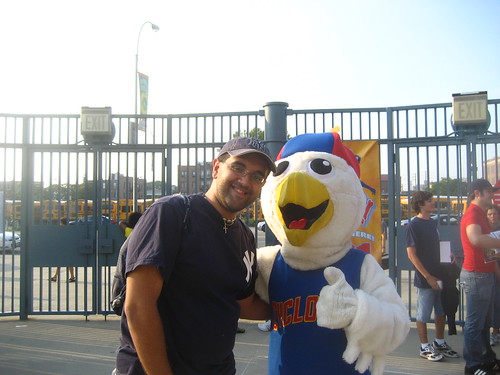
We took the long D train ride all the way down to Coney Island, headed over to Keyspan Park and sat through the first couple of innings of Short Season A ball.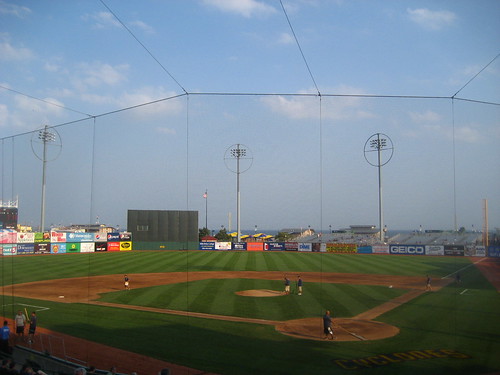
Let me tell you, in that first inning, the Cyclones played both like an affiliate of the New York Mets and like a class A team.
After a while, we got a little tired, not so much of the game itself, but the summer camp sitting next to us. Lots of kids. Lots of very, very LOUD kids. So we decided to get up and walk around.
The cool thing about Keyspan Park is that part of the park--or at least part of it accessible via the same ramp that leads to the bleachers--is a separate turf field. It's got two soccer goals and a home plate and mound area, still outlined in chalk.
So Brent, who came prepared with a glove and a baseball, and I did the only thing one could possibly do in those circumstances: We took turns pitching and catching.
I tried every grip I knew: two-seamer, curveball and knuckleball. The only one that was a strike on a consistent basis was the knuckleball, but don't let me fool you. The fastest I've ever thrown a pitch is 30 MPH, and even pitching from a flat mound that was probably closer to 50 feet from home plate than 60 feet 6 inches, there were quite a few pitches that came, well, uh, short.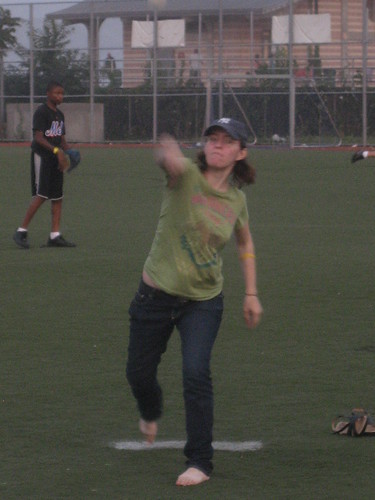
My pitching form is only slightly less embarrassing than my batting stance, which really doesn't say much...
In other words, please, please, please don't ask me to throw out the first pitch any time soon...
At any rate, we stayed there, switching on and off for about an hour.
My one, real shining moment came when Brent was attempting a side-arm delivery. After quite a few pitches that were nowhere near the strike zone, I was sort of joking, sort of not when I blurted, "you're throwing across your body too much. More arm, less body."
Strangely, the advice worked--the next three throws were all strikes.
Still, on that field I realized something: this is something every minor league park should have. While it would be unfeasible for a major league park to do so, the idea that one can go immediately from watching a game, to playing it, to watching again tugs at the very heartstrings of what this game is about.
After darkness fell and it became impractical to continue, Brent and I ended up exiting the ballpark to take in some delights of the Coney Island pier at night.
Oh, and for what it's worth, some dude on the Hudson Valley Renegades hit a home run that took out the video board in left field.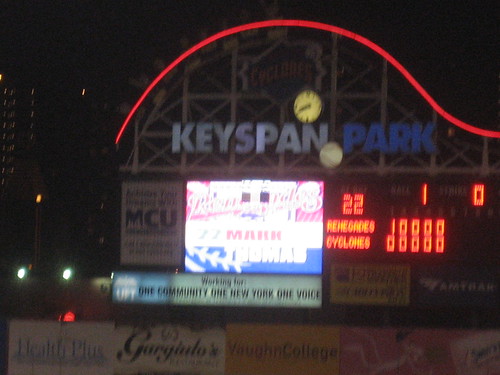
Tuesday, August 4, 2009
How I discovered that I could throw a knuckleball for a strike


Monday, August 3, 2009
The Melky Cabrera Appreciation Post
I've written posts before where I've pointed out that Melky Cabrera, in 2009 has found an unusual success in hitting in "clutch" situations.
Now, after yesterday's Cycle, it seems timely to take a look at his entire season.
Last year, Melky Cabrera's season was so poor that about this time, he was sent down to the minor leagues.
This season, his .292 average is second only to Robinson Canó and Derek Jeter. Although his .356 on base percentage is at the low end among Yankee starters, is actually higher than that of Jorge Posada.
Cabrera's numbers thus far appeared skewed by a poor June, but here it's probably worth consideration that when he crashed into the wall and banged his shoulder, it probably messed with his swing just that little bit.
Now, this is not to say that Cabrera's having an All Star caliber season--he's not--but what he is having is a season in which he's done a complete 180 from last year.
Maybe we should have expected it.
After all, Cabrera is only 24 years old. Like the young Yankee pitchers, maybe he was simply doing the 'struggling-young-player' bit.
Time will tell.
Sunday, August 2, 2009
Cabrera Hits for Cycle and Yanks Avoid Sweep (Postgame Notes 2 August 2009)
After sliding into third and being called safe, Melky Cabrera leaped up, punched his fist in the air and shouted a Spanish phrase I won't repeat here.
He had just completed the cycle, saving the hardest hit to get--the triple--for the last.
It was the first cycle for a member of the Yankees since Tony Fernandez in 1995.
So if you got caught up in the remarkable-baseball-feat-hoopla, you can perhaps be forgiven if you forget the largest context in which the cycle was hit.
The 8-5 final score is not really indicative of a well pitched game, but it's a bit misleading--while the Chicago White Sox scored four of their five runs in one inning, the Yankees scored in four different innings.
Aside from the bottom of the third, CC Sabathia was just fine, but blowing the original 3-0 lead is a little, as Michael Kay says, disconcerting. While it's great to see a pitcher get it together after struggling early, Sabathia isn't being paid to just give the Yankees a chance to win; he's being paid to pitch quality starts.
Still, the Yankees get to leave Chicago with a win heading into a very much needed off day. They come back to face Halladay, have Mitre pitch on turf in Toronto, and then have four with the Red Sox.
Good thing the Yanks are in first, eh?
Oh, and for what it's worth, Jerry Hairston Jr. has been great so far. Not great as in Albert Pujols, but great as in, Brian Cashman still knows what he's doing and he's a major upgrade over Cody Ransom.
Jesus Montero Out for Season
Via Pete Abraham, and others,
Jesús Montero, the Yankees top prospect, is out for the remainder of the minor league season after sustaining a broken middle finger.
Mike Ashmore is reporting that Montero may play in the AFL.
He had previously been named the third rated prospect in all of baseball--not bad for a 19 year-old and the youngest active player in the league.
I plan on catching a Trenton game next weekend; I'd hoped to see Montero, but alas fate has other things in store.
Still, the silver lining here is that it is a broken finger for a catcher; not something more disturbing or career-altering like a shoulder injury for a pitcher.
Remembering Munson
How do you remember Thurman Munson when you are too young to have seen him play?
Munson, the Yankee catcher of those late seventies championship teams, was killed in 1979. I was born in 1986.
Unlike Don Mattingly, whom I never saw play since my interest in baseball did not develop until after he retired, I literally never had a chance to see Munson play, in the same way mos of you, dear readers, are too young to have ever seen Babe Ruth or Lou Gehrig.
Still, the stories always seem to find a way to trickle down.
Little by little, you can start to piece together a picture, like a jigsaw puzzle, and you come up with a man that was every bit a Yankee as those he played with, and one whose death, thirty years later, can still tug at one's soul.
To lose a player at all is devastating. To lose one in the heat of August, in the heat of a division race, not from any disease but from an accident, is an awful thing.
Yet perhaps it is of some comfort that now Munson keeps company with the likes of all those other Yankees who have left us, some before our time and some during, and who watch over the team, granting it that little extra bit of help now and then.
That dropped pop up, that stolen base because the ball went into to center field, that ball four...
Saturday, August 1, 2009
Word to the Wise
Say you're down in a game 7-3 in the later innings.
You've got runners on first and second and two outs.
You have Hideki Matsui, Johnny Damon and Eric Hinske on your bench.
You decide, instead, to let Cody Ransom hit.
You, my friend, deserve to lose the game, and, pending the importance of the game, possibly more.
So the Yankees have a budget, after all (?) (!)
Or, Another way of considering the Trade Deadline
I have been told that I look for causation in everything.
I don't deny the charge. My background, as a student in history, is such that I do so by habit. If there is a Y, there must be an X.
Sometimes, there is multiple causation. Take, for instance, any great war. There is, at face value, multiple causes.
Even so, for the general rule of things, one simple rule applies: the simplest explanation is often the best.
Such, I have argued, is the case with Joba Chamberlain--pitching innings in the major leagues now that should have been pitched in the minor leagues, Chamberlain faces the normal developmental struggles a young pitcher should expect without the aid of a safety net. Fortunately for the Yankees and their fans, Chamberlain seems to have figured something out in his last few starts, but this is digression.
I would like to consider both these stipulations: that I always look for causation, which hinders my argument, and that the simplest explanation (Occam's Razor) is the best, which helps it.
I would like to consider both of these and apply them to the Yankees' recent behavior this trade deadline, a comment made by Joe Girardi after tonight's game, and what we may be hearing bandied about.
I am going to start, however, by asking you to think back to Christmas 2008, or, a couple of days before.
The Yankees had already shocked no one by signing CC Sabathia to a seven-year, $161 million contract. They had already shocked some by signing AJ Burnett to a five-year, $83 million contract.
Then, the bombshell announcement: the Yankees had signed Mark Teixeira to an eight-year, $180 million contract.
For the fans, this seemed like Christmas, indeed. The top three free agents in that off-season all ended up in pinstripes, and all locked up for what may very well amount to the defining portion of their careers. All three capable of all-star caliber play. All three clear upgrades over what the Yankees had in those positions in 2007 and 2008.
All three more expensive than most teams could afford, even had the American (and global) economy not collapsed in the preceding autumn.
While my younger brother and I were celebrating the Teixeira signing, my older brother issued a stern warning: "I don't like what the Yankees are doing. It's going to drain them. They're going to go bankrupt if they continue like this."
Now, the comment might be taking things to an extreme, but it appears that it is not wholly without merit.
Consider the activity and non-activity surrounding the trade deadline:
- The Yankees, in first place and with one of the top three records in baseball in the weeks preceding, did not need to move mountains. They had--and still have--a need at the fifth starter, a need made all the more urgent when it became abundantly clear that Chien Ming Wang would not return this season. The Yankees already had a need at the position, since from the start of the season it was known that Joba Chamberlain would have an innings limit. Though the panic move that ultimately sent Phil Hughes to the bullpen eliminated one option, others should have remained had there been some more depth at AAA. No one expected Ian Kennedy to have an anuerysm, for example.
- Even so, in the past week, the Yankees have learned, 1) Chien Ming Wang is gone for the year, 2) Alfredo Aceves--the emergency starter candidate du jour--had a tired shoulder, and certainly doesn't look recovered, 3) Sergio Mitre works as a fifth starter against last place teams and little else, 4) the depth at AAA was so bad that the team had to trade for Jason Hirsch, who was pitching to a 6.00+ ERA at that level for Colorado.
- The Yankees' only real other need was another back-up outfielder, but in this case there were in-house options available. The Yankees didn't need another power-hitting corner fielder, they just needed someone that could play halfway decent defense in center and run the bases, at least until Brett Gardner returns. Another reliever would have been nice, too, but not nearly as necessary as another starter.
- The two biggest pitchers rumored to be available at the deadline, Roy Halladay and Cliff Lee, were mostly discussed by fans (and writers) in the context of "don't-let-Boston-get-them". I, of course, don't know about the Yankees' plans, but it seems that JP Ricciardi overplayed his hand with Halladay and the Yankees never seemed to seriously consider Cliff Lee--at the very least, he didn't seem to be much discussed.
- There wasn't much of a "second-tier" of available pitchers. Jarrod Washburn and Ian Snell were probably the only ones that fit into this catergory, and even Snell here is a stretch. Still, Snell, along with his compatriot Jack Wilson were sent to Seattle earlier this week. That left many Yankee fans clamouring for Washburn, and though it was later revealed that it would have cost Austin Jackson, Washburn did end up in Detroit for the price of Luke French.
- Of more interest is this: it was rumored, partly by Joel Sherman, that the Yankees turned down a potential deal for Brian Bannister of Kansas City because they couldn't get Kansas City to continue to pay the remainder of Bannister's $650k salary--which would be closer to $910k when accounting luxury revenue. These are Bannister's stats, if you're interested. They're nothing spectacular--he's doing it in the weak AL Central--but they'd probably translate better than what Sergio Mitre has been doing.
- In acquiring Eric Hinske, the Yankees got Pittsburgh to pay the rest of his salary. It seemed insignificant enough at the time, right now...not so much.
- Now consider the following posts from Matthew Cerrone at MetsBlog.com and from Mike Silva's NYBD:
"…Mets fans will find particularly interesting:
…in talking to people around the game today, there is a lot of chatter about how the Yankees are being pressured from investors to cut spending and start delivering a dividend for once… in other words, the Yankees are unable to spend like they used to, and the gravy train may be coming to end, not surprising in this economy… in other words, nothing can last forever, and there is no such thing as an unlimited budget… "(found here)
- "Our main source down in Tampa just called to tell me that it appears that, sadly, the Yanks are sitting this one out. There appears to be less than a 10% chance that Cashman will make a move of any kind, let alone a major deal. Financial constraints, and not wanting to move any of the prospects, are the two main reasons." (found here)
- Now consider a comment made by Joe Girardi during tonight's postgame report after a 10-5 loss to the Chicago White Sox: “I’m not sure that we have a lot of options at this point, [Mitre] has got to get it done for us.” That's a little concerning. It's one thing not to have a lot of options and quite another to admit that it's the case, especially on a day such as the trade deadline, when every team wants to come off for their fans and for the public as though it is they who are the big winners. To admit that the Yankees don't have a lot of options on a day like today is, could be in a sense, insinuating that Cashman hasn't done his job. I don't see it as that--I see it more as a comment to the effect that Cashman's hands may have been tied--maybe, for whatever reason, he couldn't do much.
- Mets, Cardinals and Cubs fans and bloggers I have talked to have all told me they've heard or read whispers about the Yankees having financial constraints this year. From Yankee fans, I hear mostly that it's hogwash to think so, because, hey, they're the Yankees. Here, however, it's probably important to remember that as Yankee fans we are inherently biased. We don't want to believe that the Yankees can be mortal just as any other organization.
What I'm left with is the notion that taking on the Sabathia, Burnett and Teixeira contracts, in edition to those of Derek Jeter, Alex Rodriguez, Jorge Posada, Mariano Rivera, and, yes, Kei Igawa, has left the Yankees financially inflexible.
It's true that the Yankees have drawn remarkably well in a bad economy and in one of the coldest and wettest summers in recent memory, but I feel this may only be a mask.
The bigger piece here to consider is the YES network--by far the most successful of any of the regional sports networks. If the Yankees are drawing the revenue from the network that everyone thinks they are drawing, then it should be more of a question of the Yankees choosing not to spend more as opposed to being unable to do so.
Still, the added payroll is no small thing. Just because the Yankees could go out and spend another $30 million doesn't mean that they should. I point to Matthew Cerrone's quote above, where he states that investors are looking for a return on the investment. Investors is a vague term, but it's hard to believe that those responsible for supporting the YES network, such as sponsors or Goldman Sachs, aren't included here.
One must remember that the Yankees don't just have to deal with these massive contracts this year; Posada and Sabathia will take them to 2011; Burnett to 2013; Teixeira to 2015 and Alex Rodriguez to 2017.
There's no doubt that the Yankees right now are helped in that guys such as Melky Cabrera, Brett Gardner, Phil Hughes, Joba Chamberlain and others are still cost controlled, but the honest truth is that no other team even comes close to what the Yankees have spent.
I don't know if there was more to the Yankees not getting Brian Bannister--such as Kansas City asking for Austin Jackson or Jesus Montero--but if one considers that the Royals traded for Yuniesky Betancourt, it seems odd, indeed.
It's one thing if a Halladay-like $15 million salary is a sticking point--most teams cannot afford that--though the Yankees are theoretically one of the few that can.
It is an entirely different thing when a $650k salary, or when the Pittsburgh Pirates are asked to continue to pay the salary for your utility bench guy with a l'il pop. That is Tampa Bay Rays-ish territory.
Maybe the Yankees have some grand plan for the 2009-2010 offseason, in which they acquire Jason Bay trade with the Nationals for Stephen Strasburg (assuming he ever signs), but the word on the street is that the 2010 free agent class is notable for being thin. Maybe the Yankees hope to pick someone up off of the waiver deadline, but other teams can block waiver deals. That seems a risk, indeed, when Ian Snell, Jarrod Washburn, Brian Bannister et. al. were available this time.
Of course, I don't have access to the Yankees' financial records. This post here is nothing more than speculation at 2.30 AM while the notions are fresh in my mind.
Still, I would urge you to keep your eyes and ears opened.
That the Yankees would have any sort of budget should surprise no one but what may be surprising, however, is to see how tightly the Yankees have stretched it.; history is rife with kings and queens that plunge their country into bankruptcy because they overspend from theoretically limitless coffers. Such are among the causes of the French and Russian revolutions.
It would seem a much less daunting task for financial insolubility to cause trouble for even the exalted Yankees.